Every organization talks about performance.
Managers set goals, HR teams run review cycles, and employees are evaluated regularly. Yet many companies still struggle with a fundamental question: How do we actually measure performance in a clear and objective way?
This is where KPIs play a critical role. Without KPIs, performance conversations often rely on subjective opinions or vague expectations. Managers may believe employees are performing well, while employees themselves may not fully understand what success looks like.
KPIs solve this problem by providing measurable indicators that show whether progress is being made toward specific goals.
When used correctly, KPIs bring structure and clarity to performance management. They help managers track progress, guide employee development and align individual work with organizational priorities.
But to achieve this, organizations must understand not only what KPIs are, but also how to design and use them effectively.
Understanding the Role of KPIs in Performance Management
One of the most common misconceptions about KPIs is that they are the same as goals. In reality, they serve different purposes.
Goals describe what an organization or employee wants to achieve. They represent the desired outcome.
KPIs measure whether that outcome is being achieved.
For example, a sales team might set a goal to expand its presence in a specific region. The KPI associated with that goal could be increasing sales in that region by 10% within a defined time period.
In other words, the goal defines the direction, while the KPI measures progress toward that direction.
In performance management, KPIs act as a bridge between strategic objectives and day-to-day work. They translate broad organizational ambitions into concrete metrics that employees and managers can track and discuss over time.
This is why KPIs are most effective when they are developed collaboratively. Managers and employees should work together to define indicators that reflect both business priorities and the employee’s specific role.
When KPIs are clearly defined, they become a powerful communication tool. Employees understand what is expected of them and managers have a clear basis for evaluating performance.
How KPIs Are Used to Measure Employee Performance
Once goals have been defined, KPIs provide a structured way to evaluate progress.
Effective KPIs are always measurable and time-bound. They allow both managers and employees to track performance over a defined period — monthly, quarterly or annually.
Performance KPIs generally fall into two categories.
- Process KPIs track activities that contribute to a result
- Outcome KPIs measure the final result itself
For instance, in a sales organization, generating a certain number of leads each month might be considered a process KPI. Closing deals and achieving a revenue target would represent outcome KPIs.
Both types are important.
Process KPIs help managers understand whether employees are performing the right activities. Outcome KPIs show whether those activities ultimately produce results.
When used together, they provide a much clearer picture of performance than outcome metrics alone.
Regular review of KPIs is also essential. Performance metrics should not only be discussed during annual reviews. Instead, they should be reviewed continuously through check-ins, dashboards and performance conversations.
When employees can see their KPIs in real time, performance discussions become more productive. Instead of debating perceptions, managers and employees can focus on concrete data.
What Makes an Effective KPI
Not every metric qualifies as a useful KPI.
Poorly designed KPIs can create confusion, encourage the wrong behaviors or measure things that employees cannot realistically influence.
Effective performance management KPIs typically share several important characteristics.
- They must be aligned with organizational objectives. A KPI that does not contribute to company goals may create activity without delivering meaningful impact.
- KPIs should be measurable and clearly defined. If a metric cannot be tracked consistently, it cannot serve as a reliable performance indicator.
- Employees must be able to influence the KPI through their work.
- KPIs should be simple and easy to understand. Employees should immediately understand what the metric represents and how their actions affect it.
- KPIs must be tracked and communicated regularly. If performance data is difficult to get or delayed by weeks or months, it becomes much less useful for guiding improvement.
When these principles are applied consistently, KPIs become an effective tool for managing performance rather than a confusing collection of metrics.
Examples of Performance Management KPIs
KPIs vary widely depending on industry, role and business strategy. However, most organizations use a combination of operational, financial and engagement metrics to evaluate performance.
For example, sales performance is often measured through metrics such as total sales volume, conversion rates or revenue generated within a specific period.
Customer-facing roles may use customer satisfaction metrics, such as NPS or customer feedback ratings, to assess service quality and long-term client relationships.
Organizations that prioritize product quality might track defect rates, service errors or quality audits as indicators of performance.
Some companies also monitor employee engagement or satisfaction metrics, recognizing that engaged teams tend to produce better results and deliver stronger customer experiences.
The key lesson from these examples is that KPIs should always reflect the organization’s strategic priorities. Metrics that are valuable in one organization may be irrelevant in another.
Making KPIs Part of a Continuous Performance Process
KPIs are most powerful when they are embedded in a broader performance management process.
Rather than being reviewed only during formal evaluations, they should be discussed regularly in check-ins and one-on-one meetings. This creates an ongoing feedback loop that helps employees adjust their work, address challenges and improve performance continuously.
Technology also plays an increasingly important role in this process. Modern performance management platforms allow organizations to track goals, monitor KPIs and visualize progress in real time.
When managers and employees can access performance data easily, discussions shift from subjective impressions to evidence-based insights.
This transparency makes performance management more constructive and less stressful for everyone involved.
How KPIs Work in Okrate
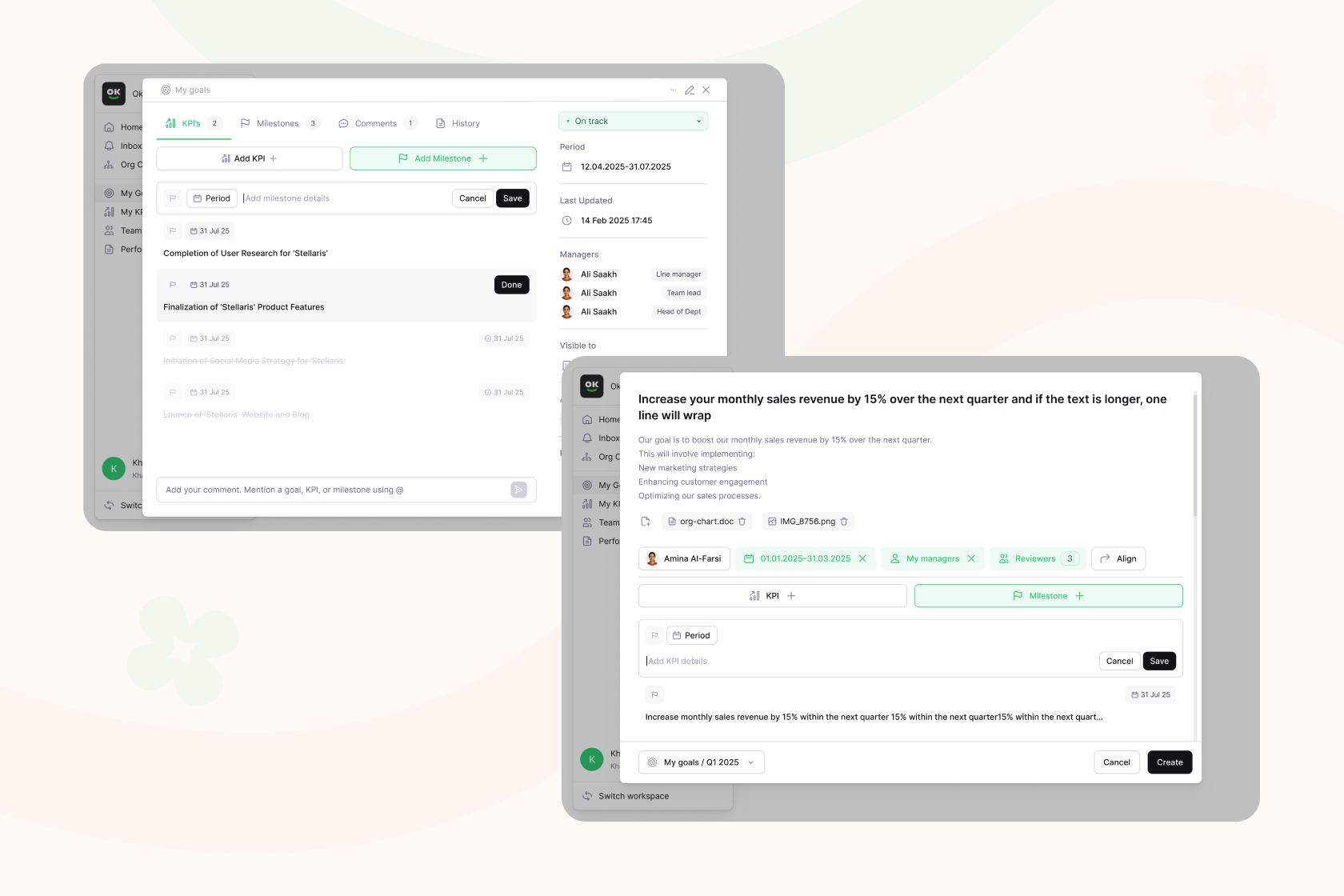
Okrate helps organizations turn KPIs from static metrics into a transparent performance system.
Goals and KPIs in one place
Define goals and attach measurable KPIs directly to them so employees clearly see how their work contributes to team and company priorities.
Milestones for better progress tracking
Break large goals into smaller milestones that help teams track progress step by step.
Real-time visibility
Managers and employees can see goal progress, KPI status, and milestone completion in real time.
Automated reminders and notifications
The system sends reminders to update goals, track progress, and complete performance activities on time.
Transparent performance conversations
Everyone involved — employees, managers, and HR — can see the same performance data, making discussions more objective and productive.
KPIs are not just measurement tools. They are a way to align effort, clarify expectations and guide performance conversations.
When employees understand how success is measured, they are better equipped to prioritize their work and make decisions that support organizational goals.
For managers, KPIs provide a clear framework for coaching, feedback and evaluation.
And for organizations as a whole, well-designed KPIs create visibility into performance trends, helping leaders identify opportunities for improvement and growth.
In the end, the goal of performance management is not simply to measure performance. It is to help people perform better. Well-crafted KPIs make that possible.