Companies in 2026 face a familiar challenge: everyone is busy, but not everyone is moving in the same direction. Teams set goals, individuals plan their work and leadership defines the strategy but without a clear system that connects these pieces, organizations end up with misalignment, duplicated efforts or priorities that constantly shift.
This is where cascading goals become valuable. Cascading goals help translate high-level company objectives into team priorities and individual responsibilities. When used correctly, they bring clarity, accountability and alignment. Research from McKinsey shows that organizations with clear alignment between strategy and day-to-day work are significantly more likely to achieve their goals and outperform competitors.
This article breaks down how cascading goals work, what HR teams need to consider and how to introduce them without overwhelming managers and employees.
What Are Cascading Goals?
Cascading goals are a structured way to align the entire organization around shared priorities. The cascade starts at the company level, moves to departments and teams, and then connects to individual goals.
But this is not about pushing goals downward. It’s about connecting the big picture to everyday work.
So, the idea:
- Leadership defines company goals
- Teams translate those goals into functional priorities
- Individuals set goals that contribute to team outcomes
In this ase, everyone understands:
- what the company aims to achieve
- how their team contributes
- what their own responsibilities are
This creates an alignment system in a company.
Why Companies Use Cascading Goals
Cascading goals help solve the most common issues HR and managers face:
1. Employees don’t understand company priorities
Surveys from Gallup show that only about half of employees clearly understand what is expected of them and how their work connects to company goals. Cascading goals solve this by giving employees a line of sight from “company strategy” to “my daily work”.
2. Teams work in isolation
Cascading goals highlight cross-team dependencies early, helping teams coordinate work instead of discovering misalignment too late.
3. Managers have difficulty in setting priorities
Clear cascaded goals give managers a framework for:
- what matters now
- what can wait
- what should be deprioritized
4. Performance becomes fairer and more objective
When goals are connected to company priorities, evaluations rely more on clear contribution and less on assumptions or perceptions.
How Cascading Goals Work
Cascading goals follow a predictable flow:
1. Company-level goals
These are strategic and long-term:
- revenue targets
- customer outcomes
- new market expansion
- product launches
- culture or organizational development goals
These set the direction.
2. Department or team goals
Teams translate the company goals into function-specific outcomes.
Example of cascading goals for teams: If the company wants to expand into a new region, teams contribute differently:
- Marketing: local market campaigns
- HR: hiring for the new region
- Product: localisation improvements
Teams focus on what they can directly influence.
3. Individual goals
Managers help each employee define goals that support the team’s priorities. These goals are clearer, more actionable and easier to track.
Example of cascading goals for individuals: If the team’s goal is “Improve customer retention,” an individual goal might be:
- Reduce customer response time by 20%
- Improve onboarding satisfaction scores from 82% to 90%
This is where clarity becomes daily execution.
Best Practices for Implementing Cascading Goals
Cascading goals only work when they’re implemented carefully. Below are the practices HR and managers should follow.
1. Start with clear, inspiring company-level objectives
Every cascade begins with the top of the organization. If company goals are vague, everything below becomes unclear.
This step must be driven by the CEO and executive leadership. They need to formulate a small set of clear, measurable and inspiring objectives. The best top-level goals balance two things:
- Specificity. So everyone can tell whether the goal has been achieved
- Inspiration. So people care enough to contribute to it
Examples of strong company-level goals:
- Increase annual recurring revenue from $12 million to $18 million by the end of the year.
- Increase customer retention from 75% to 85% by the end of the financial year.
Fewer top-level goals generally lead to stronger alignment. But if a company has multiple strategic priorities, the most important thing is not the number of goals, it is clear communication and a consistent process for cascading them down.
2. Departments should translate company goals into team-level priorities
Once the strategic goals are defined at the top, each department needs to translate them into its own set of goals.
This process starts with transparent communication. Teams must understand:
- what the company is trying to achieve
- why it matters
- and how their function contributes
Departments should evaluate their own strengths, risks and opportunities. The key is not to assign tasks from the top or dictate operational steps. Instead, leadership should set direction and teams should decide how they will achieve it.
This helps to maintain:
- engagement
- autonomy
- ownership
- accountability
When teams are involved in defining their contribution, they are more focused on implementing it.
3. Managers align team and individual goals with department priorities
After departments define their goals, managers play a critical role in connecting them to day-to-day work. This is where cascading becomes both strategic and personal.
Managers need to:
- hold open conversations about how individual work supports team outcomes
- help employees set measurable, meaningful goals
- ensure alignment across all levels
- collect upward feedback so leadership understands ground-level reality
This two-way communication is essential. Cascading goals are not only top-down, they must also move bottom-up. Because management needs to be aware of:
- workload pressure
- problems
- limitations
- feedback that may require goal adjustments
4. Ensure cross-functional visibility to avoid silos
Cascading goals don’t work without transparency. Even if each team is aligned internally, departments may still move in different directions if they cannot see each other’s goals.
Cross-functional visibility:
- highlights dependencies
- prevents duplicated work
- reveals conflicting priorities
- keeps everyone aligned on shared outcomes
Some organizations successfully combine cascading goals with the OKR framework. In quarterly OKR reviews, teams not only assess results but also discuss how their work aligns with company values and cross-team priorities.
This makes it easier to coordinate projects that involve multiple functions — marketing, product, sales, HR, finance, operations.
Transparency is also directly linked to accountability and incentives. When goals change, compensation and incentive systems must adapt to new priorities.
5. Use SMART goals to add clarity and make cascading measurable
Even in cascading-goal systems, the SMART model is essential to ensure:
- specific outcomes
- measurable indicators
- achievable targets
- relevant alignment
- time-bound deadlines
6. Review and adjust goals quarterly
Priorities shift, so cascading goals must shift with them. Quarterly reviews allow teams to:
- adjust timelines
- revise targets
- remove outdated goals
- realign with new business realities
- catch misalignment early
This also reduces pressure on annual reviews by distributing feedback and alignment throughout the year.
7. Promote transparency at every level
Share updates regularly through:
- team meetings
- leadership updates
- dashboards
- Slack/Teams channels
- dedicated performance tools
When people can see goals, they work with more confidence and direction.
8. Use HR technology to spot misalignment and blockers early
Many companies struggle with cascading goals because they try to manage them in spreadsheets or multiple disconnected tools. This leads to outdated documents, unclear ownership and inconsistent updates.
A platform like Okrate helps by offering:
- Clear goal-setting at all levels
Company, team and individual goals can be linked together so everyone sees how their work contributes.
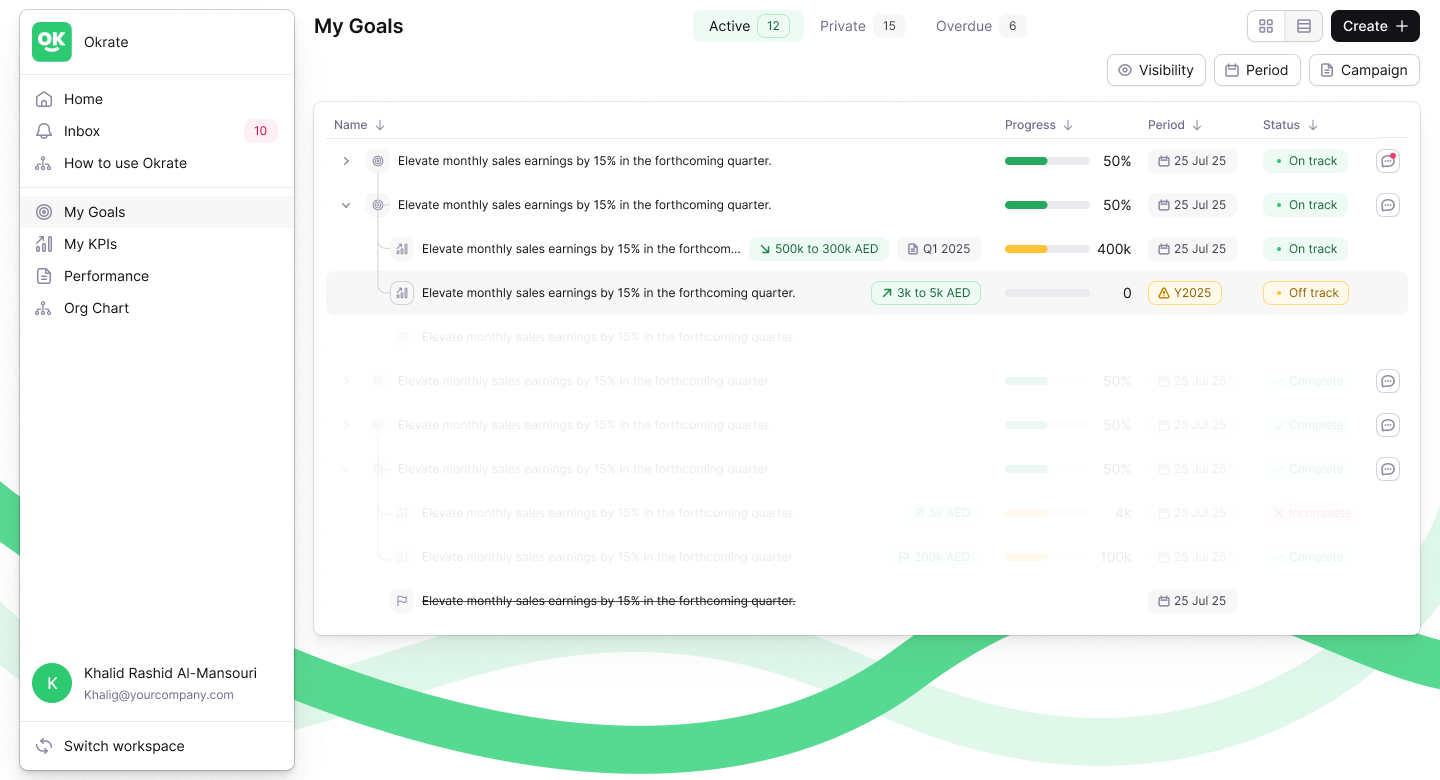
- Cascading made simple
Managers can quickly align goals across levels without re-creating structures manually.
- Visibility and transparency
Employees can see:
- team goals
- manager goals
- company-wide priorities
- their own contribution
- Real-time dashboards
Progress updates automatically — giving HR and leadership a clear picture of alignment and performance.
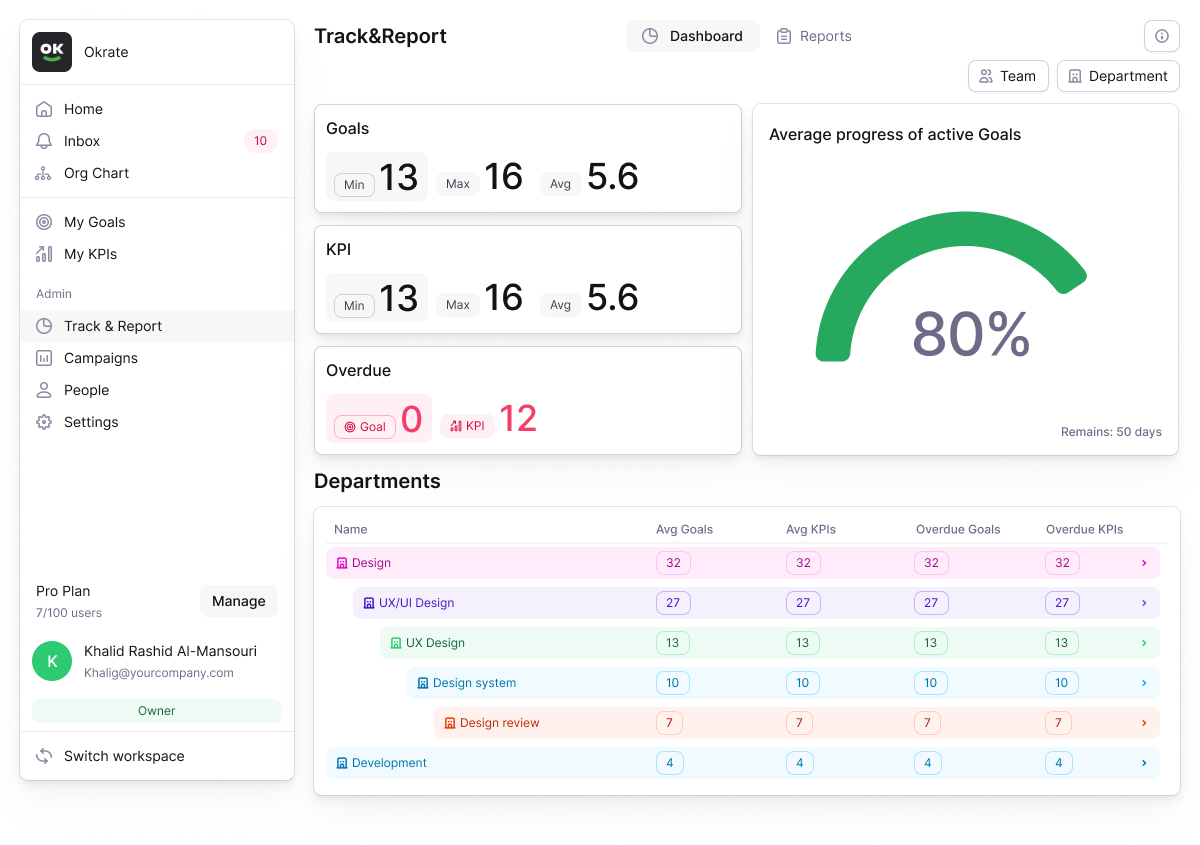
- Milestones, KPIs and check-ins
Teams can break big goals into manageable steps and track them through the quarter.
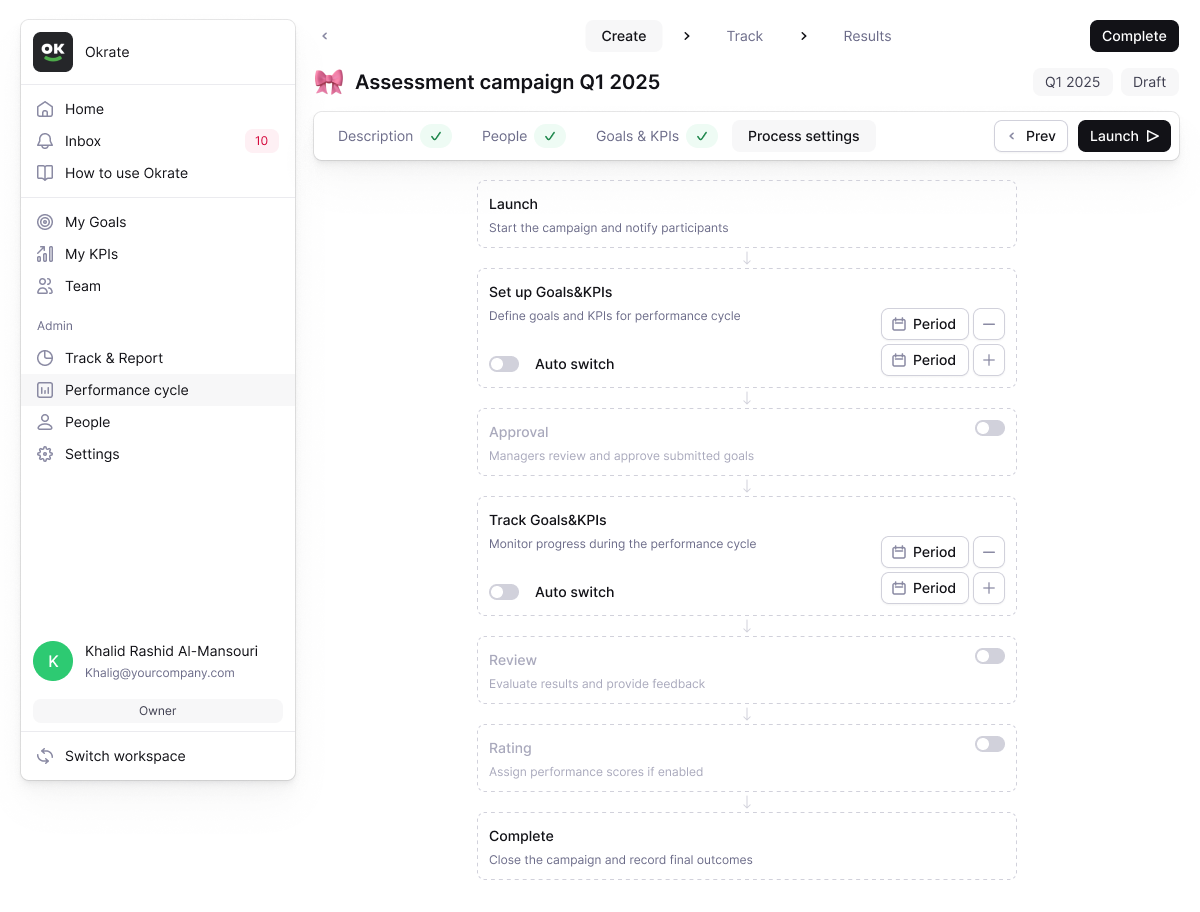
- Clear performance cycles
HR can run structured goal-setting and review periods across teams and departments.
- Feedback tied to goals
Employees receive relevant feedback connected to the goals they are working toward.
Cascading goals are only effective if teams can see, update and discuss goals easily — Okrate turns cascading from theory into daily practice.