For many employees, the words performance appraisal still trigger anxiety. Annual meetings, ratings, compensation decisions and the feeling of being judged rather than supported are common associations. At the same time, performance reviews are often seen as more conversational and less official.
In practice, these two terms are frequently used interchangeably. Yet they serve different purposes, follow different rhythms and lead to different outcomes. Understanding the difference between performance reviews and performance appraisals is critical for HR teams and managers who want to build fair, transparent and effective performance management systems.
This article breaks down what each process really means, how they differ in practice and how modern organizations use both of them to support performance and growth.
What Is a Performance Review?
A performance review is a structured conversation between a manager and an employee that focuses on ongoing performance, progress and development.
Its primary goal is not judgment, but reflection and alignment. Performance reviews create space to discuss what is working, what is not and how an employee can grow in their role. They often include conversations about goals, skills, challenges and future priorities.
Performance reviews can be conducted quarterly, monthly or even continuously through regular check-ins. In modern organizations, they are increasingly documented in performance management systems, where feedback, goals and progress can be tracked over time.
Most importantly, a performance review is two-way. Employees are encouraged to share their perspective, reflect on their own performance and actively participate in shaping next steps.
In short, performance reviews are about:
- continuous feedback
- development and learning
- clarity around expectations
- improving performance over time
What Is a Performance Appraisal?
A performance appraisal is a more formal and structured evaluation of an employee’s performance over a defined period, usually annually or semi-annually.
Its purpose is primarily assessment and decision-making. Performance appraisals are often tied to outcomes such as compensation adjustments, bonuses, promotions or role changes. Because of this, they tend to rely on predefined criteria, rating scales and standardized processes.
While appraisals also include feedback, the tone is typically more evaluative than developmental. Input may come from multiple sources, such as managers, HR and sometimes peers, and the final result is often a documented performance rating.
Performance appraisals help organizations ensure consistency and fairness across teams, but when used in isolation, they can feel stressful, especially if feedback only appears once a year.
All in all, performance appraisals are about:
- formal evaluation
- consistency
- compensation and promotion decisions
- organizational accountability
Performance Review vs Performance Appraisal: The Core Differences
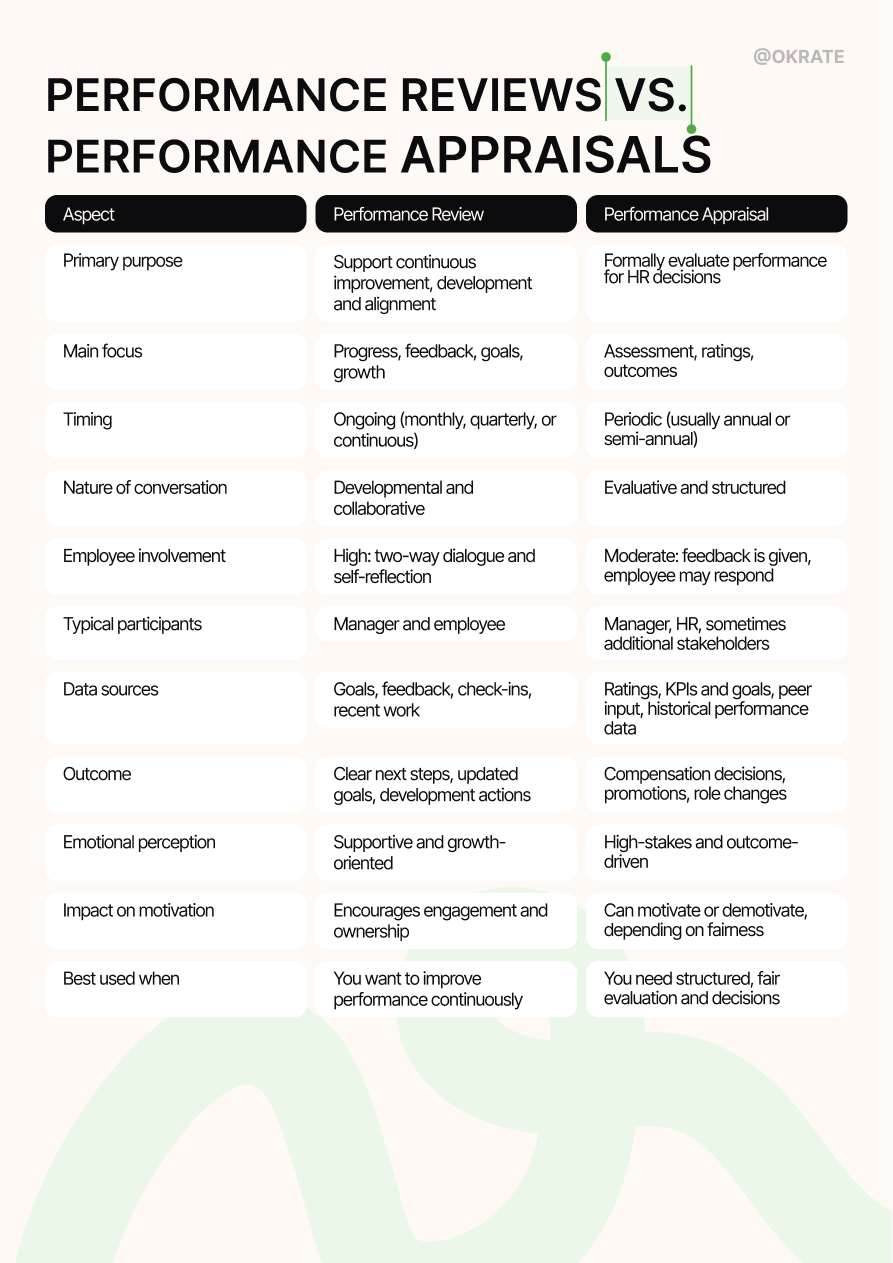
The difference between performance reviews and performance appraisals is not about which one is better. It’s about intent and timing.
Performance reviews are ongoing and developmental. They support learning, improvement and alignment throughout the year. Performance appraisals are periodic and evaluative. They summarize performance and inform HR decisions.
Another key difference lies in flexibility. Reviews are often adaptable and conversational, while appraisals follow strict rules and structures. Reviews are typically led by managers, while appraisals involve HR more directly to ensure consistency and fairness.
Most modern organizations need both. Reviews help employees grow. Appraisals help organizations make decisions.
Why Organizations Need Both
Relying only on performance appraisals often leads to delayed feedback, frustration and bias. Relying only on performance reviews can make it difficult to make consistent compensation or promotion decisions.
When combined correctly:
- Performance reviews support continuous improvement and engagement
- Performance appraisals ensure fairness, structure and accountability
Modern performance management systems help bridge this gap by connecting ongoing reviews, goals and feedback with formal appraisal cycles creating a single performance story.
The real question is not whether your organization should use performance reviews or performance appraisals. It’s whether you are using each one for the right purpose.
Performance reviews help people grow. Performance appraisals help organizations decide. When HR teams design both processes intentionally and support them with clear communication and the right tools performance management becomes less stressful, more fair and far more effective.
Used together, reviews and appraisals stop being something employees fear and start becoming something that actually drives performance and development.