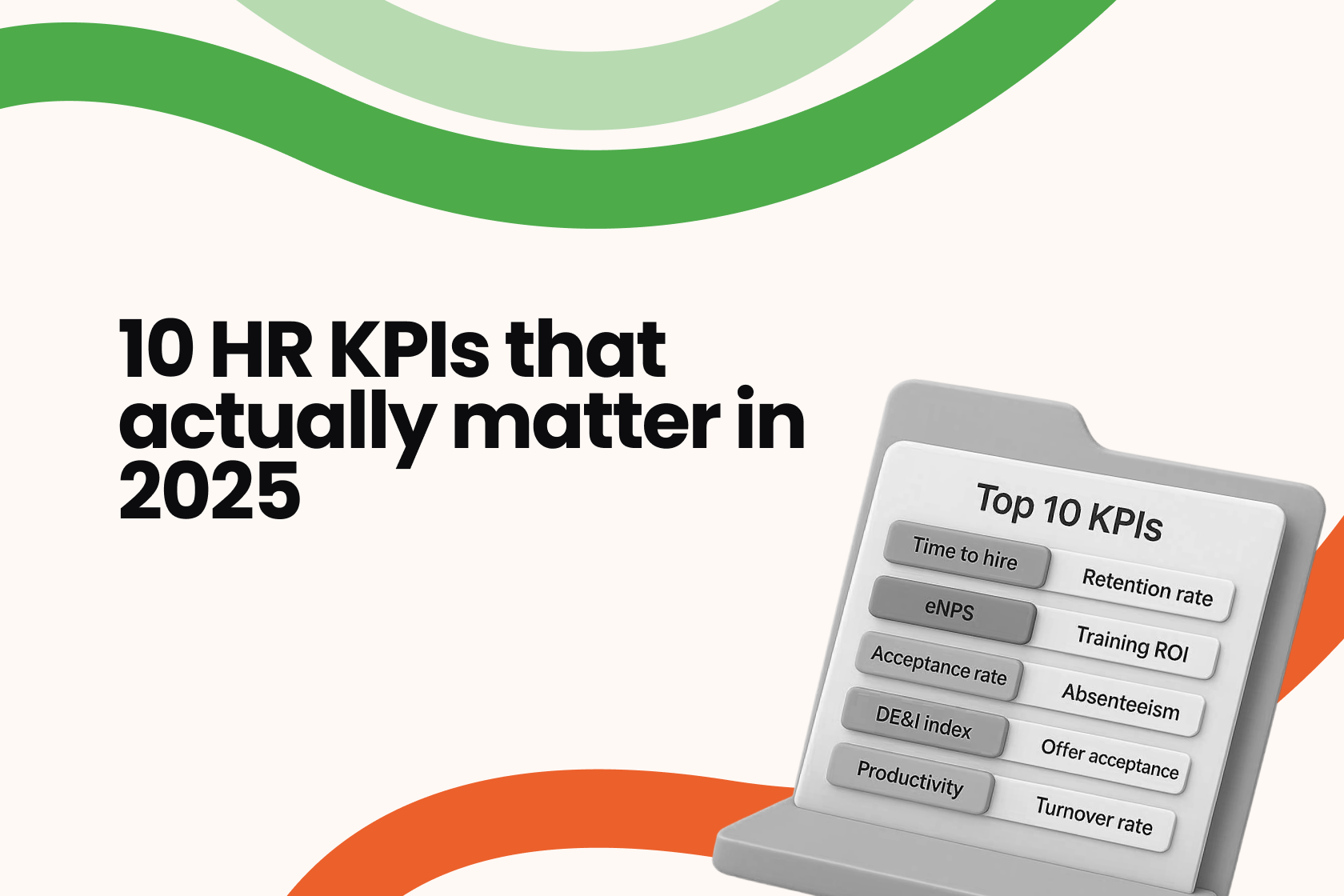
In today’s fast-moving business world, HR is no longer a back-office function. It’s a strategic force that shapes culture and drives performance. But with growing responsibility comes growing complexity and that’s exactly where HR metrics (specifically KPIs) come in.
According to a study by Deloitte, 71% of organizations see people analytics as a high priority. Yet only 8% feel they’re truly strong in it. Why the gap? Because choosing the right metrics and actually using them — is harder than it sounds.
We’re not just talking about measuring headcount or turnover. We’re talking about the kind of insight that shows whether your team is engaged, productive and aligned with company goals. And if you’re still relying on gut feel or scattered Excel sheets, you're missing out one of the most powerful HR's levers.
According to a study by Deloitte, 71% of organizations see people analytics as a high priority. Yet only 8% feel they’re truly strong in it. Why the gap? Because choosing the right metrics and actually using them — is harder than it sounds.
We’re not just talking about measuring headcount or turnover. We’re talking about the kind of insight that shows whether your team is engaged, productive and aligned with company goals. And if you’re still relying on gut feel or scattered Excel sheets, you're missing out one of the most powerful HR's levers.
What HR KPIs really do
Think of KPIs as your HR department’s compass. They don’t just show where you are — they help you figure out whether you’re moving in the right direction. Are you improving retention? Reducing time-to-hire? Building a culture that keeps people motivated and high-performing?
HR KPIs are not vanity metrics. When chosen well, they connect directly to business outcomes. Reduced churn saves money. Better engagement boosts productivity. Smarter onboarding accelerates time-to-performance.
And here’s the key: you don’t need to track everything. In fact, the biggest mistake many teams make is KPI overload. At Okrate, we often say, “Fewer, but better.” Three or four great metrics that actually tell you something are worth more than twenty vague ones.
HR KPIs are not vanity metrics. When chosen well, they connect directly to business outcomes. Reduced churn saves money. Better engagement boosts productivity. Smarter onboarding accelerates time-to-performance.
And here’s the key: you don’t need to track everything. In fact, the biggest mistake many teams make is KPI overload. At Okrate, we often say, “Fewer, but better.” Three or four great metrics that actually tell you something are worth more than twenty vague ones.
So why you need to track HR KPIs?
- Align people strategy with business goals
- Prove HR’s value with data
- Identify trends before they become problems
- Make hiring, development and retention decisions smarter
- Improve accountability across the сompany
Key areas where HR metrics matter most: types of HR KPIs
HR metrics cover specific domains where HR can directly influence business outcomes — and where the right insight can turn into competitive advantage.
1. Talent acquisition
From time-to-hire to cost-per-hire, recruitment metrics show whether your hiring process is efficient, fair and aligned with growth goals.
2. Onboarding
Getting people in the company is step one. But how quickly they become productive, engaged and integrated into the team — that’s where onboarding KPIs shine. Tracking will help you understand where the onboarding process is going smoothly and where there are weak spots.
3. Employee engagement
Engagement metrics like eNPS or participation rates in surveys reveal how your employees feel about their work and whether they see a future in your company. High engagement equals higher retention, better performance and stronger culture.
4. Learning and development
Completion rates are one thing, but it’s important to track how training impacts role effectiveness. Are employees putting what they learn into practice? Does it show in their performance?
5. Performance and goal achievement
One of the most strategic areas. Goal attainment KPIs (often tied to OKRs) show whether teams are aligned, resourced and focused on what really matters.
6. Retention and turnover
High turnover can lead to a decrease in the level of morale and budgets. Metrics in this area (like turnover, attrition) will help you diagnose causes and find solutions.
7. Culture and well-being
Modern HR leaders increasingly track well-being KPIs: absenteeism rates, burnout indicators or pulse survey fatigue signals. Because healthy teams perform better — and stay longer.
1. Talent acquisition
From time-to-hire to cost-per-hire, recruitment metrics show whether your hiring process is efficient, fair and aligned with growth goals.
2. Onboarding
Getting people in the company is step one. But how quickly they become productive, engaged and integrated into the team — that’s where onboarding KPIs shine. Tracking will help you understand where the onboarding process is going smoothly and where there are weak spots.
3. Employee engagement
Engagement metrics like eNPS or participation rates in surveys reveal how your employees feel about their work and whether they see a future in your company. High engagement equals higher retention, better performance and stronger culture.
4. Learning and development
Completion rates are one thing, but it’s important to track how training impacts role effectiveness. Are employees putting what they learn into practice? Does it show in their performance?
5. Performance and goal achievement
One of the most strategic areas. Goal attainment KPIs (often tied to OKRs) show whether teams are aligned, resourced and focused on what really matters.
6. Retention and turnover
High turnover can lead to a decrease in the level of morale and budgets. Metrics in this area (like turnover, attrition) will help you diagnose causes and find solutions.
7. Culture and well-being
Modern HR leaders increasingly track well-being KPIs: absenteeism rates, burnout indicators or pulse survey fatigue signals. Because healthy teams perform better — and stay longer.
How to choose necessary KPIs?
Tracking the wrong KPIs or too many metrics is often worse than tracking none at all. It leads to decision fatigue and overloading.So how to choose KPIs that are actually useful?
- Start with asking the right questions — not “what do other companies track?” but “what do we need to learn and improve right now?”
- Begin by anchoring your KPIs to your strategic priorities. If your company is scaling quickly, focus on recruitment efficiency, onboarding time and engagement of new hires. If retention is an issue, focus on churn rates, exit data and internal mobility.
- Also consider who’s using the KPI and what decisions they need to make. Leaders need high-level strategic KPIs. Managers need team-level operational KPIs, etc.
The HR KPIs: 10 metrics to track
Employee turnover rate
The percentage of employees who leave during a given period. High turnover is expensive not just financially, but culturally.
How to calculate: (Number of separations ÷ average headcount) × 100
Time to fill
The average number of days it takes to fill a role. Longer times mean lost productivity, increased recruiter burden and frustration for hiring managers (track this by department or job level for more insight).
Employee net promoter score (eNPS)
A simple score based on one question: “How likely are you to recommend this company as a place to work?” It’s a pulse check on sentiment, trust, and overall culture.
Time to productivity (ramp-up time)
How long it takes a new hire to perform at expected capacity. It reflects your onboarding quality, manager support and clarity of expectations.
Internal mobility rate
The percentage of open roles filled by current employees. Shows whether you’re building careers — or watching talent walk out the door. It’s also a great indicator of whether development programs are working.
Training сompletion кate
How many employees complete required (or optional) learning programs. It reflects not just compliance of education, but learning culture. Connect it with qualitative feedback to track effectiveness, not just volume.
Goal completion rate (KPI/OKR alignment)
The percentage of individual or team goals achieved per quarter. It tells you whether people are focused, aligned, and performing. If scores are low — ask why. Are the goals too ambitious, or is something blocking execution?
Manager effectiveness score
Whether via surveys, pulse check-ins or 360s, this KPI gathers data on how teams rate their managers. Great managers drive retention, engagement and performance. Gallup has found that 70% of team engagement is directly tied to the manager.
Offer acceptance rate
How many candidates are saying “yes” to your offers? This metric helps to understand how competitive employer brand and process.
Cost per hire
The total cost of filling one vacancy — including advertising, tools, agencies, managers’ time. Allows HR directors to protect budgets and optimize the hiring process
The percentage of employees who leave during a given period. High turnover is expensive not just financially, but culturally.
How to calculate: (Number of separations ÷ average headcount) × 100
Time to fill
The average number of days it takes to fill a role. Longer times mean lost productivity, increased recruiter burden and frustration for hiring managers (track this by department or job level for more insight).
Employee net promoter score (eNPS)
A simple score based on one question: “How likely are you to recommend this company as a place to work?” It’s a pulse check on sentiment, trust, and overall culture.
Time to productivity (ramp-up time)
How long it takes a new hire to perform at expected capacity. It reflects your onboarding quality, manager support and clarity of expectations.
Internal mobility rate
The percentage of open roles filled by current employees. Shows whether you’re building careers — or watching talent walk out the door. It’s also a great indicator of whether development programs are working.
Training сompletion кate
How many employees complete required (or optional) learning programs. It reflects not just compliance of education, but learning culture. Connect it with qualitative feedback to track effectiveness, not just volume.
Goal completion rate (KPI/OKR alignment)
The percentage of individual or team goals achieved per quarter. It tells you whether people are focused, aligned, and performing. If scores are low — ask why. Are the goals too ambitious, or is something blocking execution?
Manager effectiveness score
Whether via surveys, pulse check-ins or 360s, this KPI gathers data on how teams rate their managers. Great managers drive retention, engagement and performance. Gallup has found that 70% of team engagement is directly tied to the manager.
Offer acceptance rate
How many candidates are saying “yes” to your offers? This metric helps to understand how competitive employer brand and process.
Cost per hire
The total cost of filling one vacancy — including advertising, tools, agencies, managers’ time. Allows HR directors to protect budgets and optimize the hiring process
At Okrate, we’ve seen how easy it is for performance tracking to become chaotic. Ten dashboards, multiple systems and no clear visibility. That’s exactly why we built a platform to change that.
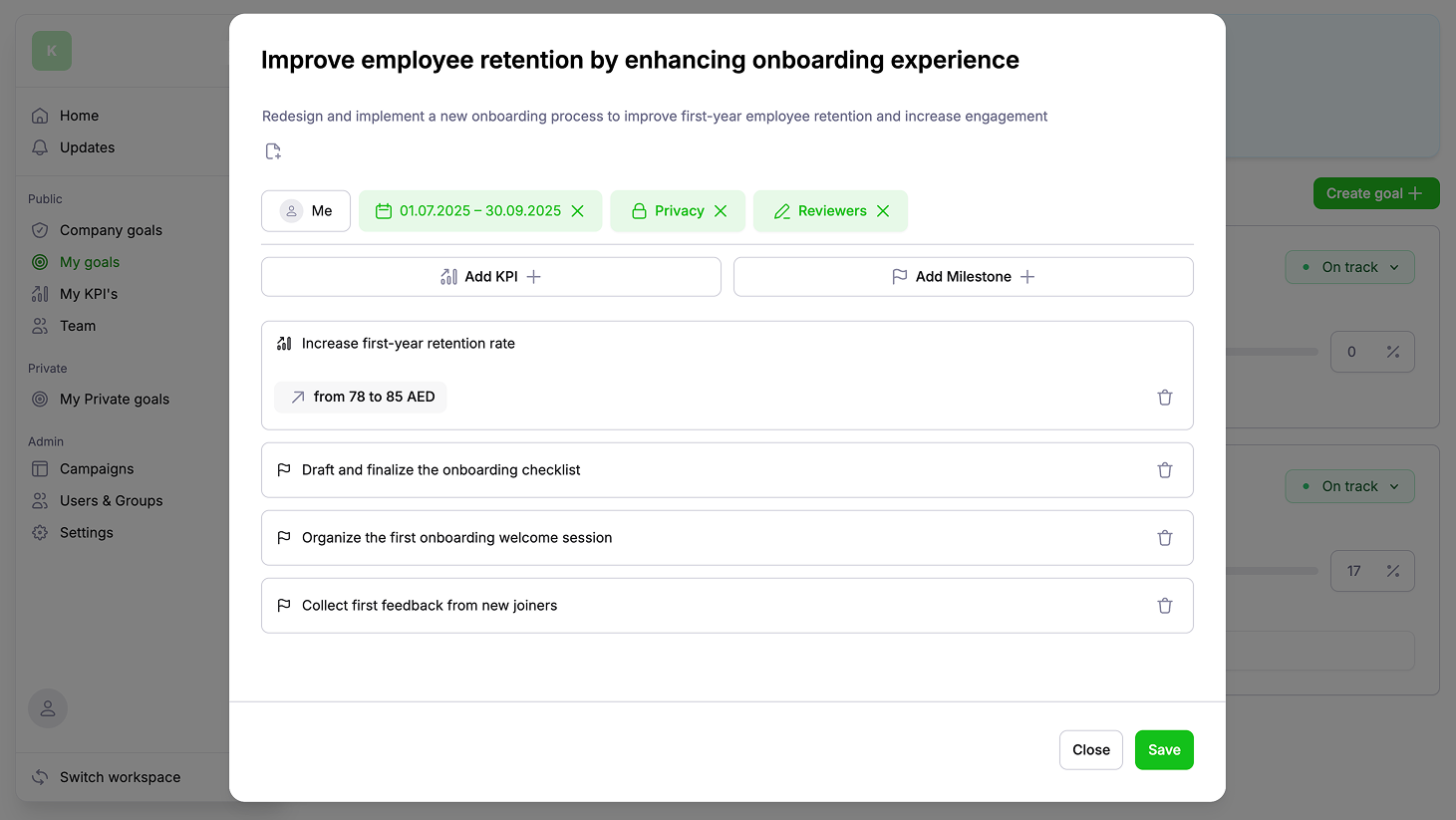
With Okrate, you can:
Want early access? Join our waitlist and be the first to know when we launch!
And if you want to go deeper into building your KPI strategy, check out these essential articles:
- Set and cascade goals that align with company KPIs
- Track progress in real time
- Monitor key HR metrics with clear dashboards
- Analyze trends and spot risks before they escalate
Want early access? Join our waitlist and be the first to know when we launch!
And if you want to go deeper into building your KPI strategy, check out these essential articles: