Measuring employee performance is one of the most important responsibilities of HR teams and managers. It helps organizations understand who is performing well, where employees need support, which teams are under pressure and whether the company is moving toward its business goals.
But performance measurement is also one of the easiest areas to get wrong.
If companies measure only numbers, they miss important context: collaboration, initiative, leadership, communication and growth. If they rely only on manager opinions, they risk bias and inconsistency. If they review performance only once a year, they often discover problems too late.
A strong performance measurement system combines several methods: structured reviews, clear goals, measurable KPIs, multi-source feedback, continuous monitoring and regular manager conversations. The purpose is not to control employees. The purpose is to create clarity, support growth and make better people decisions.
This article explains the most effective tools and techniques for measuring employee performance, how to choose the right metrics and how modern performance platforms like Okrate help make the process more transparent and practical.
What Does It Mean to Measure Employee Performance?
Employee performance measurement is the process of evaluating how effectively a person contributes to their role, team and organization. It looks at both results and behaviors.
Results answer the question: What did this employee achieve?
Behaviors answer the question: How did they achieve it?
So both of them matter.
For example, a sales manager may exceed their revenue target but create conflict in the team. A project manager may miss one deadline but show strong leadership, risk management and problem-solving under difficult conditions. A developer may complete fewer tasks than expected but significantly improve code quality or system stability.
That is why performance measurement should never be reduced to one number. It should provide a balanced view of productivity, quality, collaboration, initiative, reliability and development.
Core Tools and Techniques for Measuring Employee Performance
There is no single best method for measuring performance. The right approach depends on the company’s size, culture, roles and performance management maturity. In most organizations, the best results come from combining several methods.
1. Manager Appraisals
Manager appraisals are one of the most common ways to evaluate employee performance. They involve a structured assessment by the employee’s direct manager, usually based on goals, role expectations, KPIs, competencies and performance.
A good manager appraisal should not be based on vague impressions. It should be supported by examples, performance data, customer feedback, project results and previous check-in notes. Recommended to use defined rating scales, giving specific feedback and setting realistic goals for the next review period.
Rating scales can help create structure. For example, a company might use a five-point scale from “Needs improvement” to “Outstanding.” But rating scales only work when every level is clearly defined. Otherwise, one manager’s “meets expectations” may mean another manager’s “exceeds expectations.”
Manager appraisals are useful because managers usually have the closest view of the employee’s responsibilities, work habits and team contribution. However, they should not be the only source of performance data. Even experienced managers can be influenced by recency bias, personal preferences or limited visibility into cross-functional work.
The best use of manager appraisals is as one part of a broader performance measurement system.
2. 360-Degree Feedback
360-degree feedback collects input from several sources: the employee, manager, peers, direct reports and sometimes external stakeholders such as clients or project partners. 360 feedback as a way to measure individual performance by aggregating feedback from multiple perspectives.
This method is especially useful for roles where collaboration, communication, leadership and influence matter. A manager may see final results, but peers often see how the work actually happens: whether the employee communicates clearly, supports others, shares information and handles conflict constructively.
For example, a product manager may be evaluated not only by their direct manager, but also by engineering, design, marketing, etc. This creates a more complete picture of their impact.
Still, 360 feedback must be designed carefully. If questions are too vague, feedback becomes emotional or unhelpful. HR should provide structured questions, clear rating definitions and guidance on what good feedback looks like.
Used well, 360 feedback reduces single-manager bias and supports deeper development conversations.
3. Competency-Based Performance Appraisals
Competency-based appraisals measure how well employees demonstrate the skills, behaviors and capabilities required for their role.
This method is particularly useful when performance cannot be measured only through output. For example, leadership, problem-solving, communication, adaptability and stakeholder management are not always visible in simple KPIs.
Competency-based appraisals require organizations to define competencies, identify behaviors that demonstrate them, and decide expected mastery levels for each role and level.
For example, a project manager might be assessed on project planning, risk management, stakeholder communication and team leadership. A senior engineer might be assessed on technical quality, architectural thinking and mentoring.
The main advantage of competency-based measurement is that it helps employees understand what growth actually means. Instead of saying “improve leadership,” the company can define what leadership looks like at each level.
The challenge is preparation. Competency frameworks take time to build. HR teams need to involve function leaders, define observable behaviors and train managers to evaluate consistently. Without this work, competency reviews can become subjective.
4. Management by Objectives
Management by Objectives or MBO, measures performance by comparing actual results with agreed objectives.
In this model, managers and employees define clear goals together, create action plans, monitor progress, evaluate results and then use feedback to support improvement. MBO is a strategic management model that helps teams focus on achievable goals and work collaboratively toward them.
For example, if an employee’s objective is to increase sales revenue by 20% in the next quarter, performance can be measured through revenue generated, campaign success and improvements in conversion rates.
MBO works well because it connects performance measurement to clear outcomes. Employees know what they are trying to achieve and managers have a concrete basis for evaluation.
However, MBO should not become a rigid checklist. Goals may need to change as business priorities shift. Managers should review progress regularly and discuss whether the objective is still relevant, realistic and aligned with the company’s needs.
5. OKR Performance Management
OKRs (Objectives and Key Results) are another goal-setting and performance measurement framework.
The objective describes what the team or employee wants to achieve. Key results define how success will be measured. Objectives are high-level and motivating, while key results are quantifiable indicators used to track progress.
OKRs work especially well in fast-moving companies because they create alignment and transparency. Employees can see how their work connects to larger priorities, and managers can track progress throughout the cycle.
But OKRs should be used carefully. Too many OKRs create confusion. Unrealistic OKRs create frustration. The best systems focus on a small number of meaningful objectives and review them consistently.
6. Continuous Performance Monitoring
Continuous performance monitoring uses real-time data, analytics, regular check-ins and one-on-one conversations to measure performance throughout the year.
This approach is becoming more important because annual reviews often come too late. By the time a formal review happens, the opportunity to correct performance or support an employee may already be missed.
It’s a more dynamic and responsive approach supported by real-time metrics, analytics, performance management software and regular one-on-one meetings. It also highlights benefits such as immediate feedback, data-driven decisions and proactive management.
This method helps managers identify issues early. For example, if a goal is falling behind, the manager can discuss blockers immediately. If an employee is consistently overperforming, the company can recognize them sooner or consider development opportunities.
Continuous monitoring should not feel like constant observation. The goal is not to watch every action. The goal is to make progress visible and keep performance conversations active.
7. Balanced Scorecard
A balanced scorecard gives a broader view of performance by combining several categories of metrics.
Instead of focusing only on output, it may include financial results, customer satisfaction, process efficiency and learning or growth indicators. It helps employees understand their role and contribution to company goals, using KPIs aligned with strategic objectives.
For example, a salesperson’s scorecard might include quarterly sales results, customer retention, new client acquisition and product knowledge development.
This method is useful because it prevents companies from overvaluing one type of performance. An employee may generate strong numbers but damage customer relationships. Another may deliver excellent customer satisfaction but need support improving productivity. A balanced scorecard helps capture these trade-offs.
The key is to keep the scorecard simple. Too many metrics make the system hard to understand and difficult to use.
Common Challenges in Measuring Employee Performance
Performance measurement is never purely technical. It involves people, judgment, culture, and trust. HR teams need to manage several common challenges.
Subjectivity and Bias
One of the biggest risks in performance measurement is bias. Managers may overvalue recent events, reward people they communicate with most often or evaluate similar behavior differently across teams.
To reduce subjectivity and form a more balanced perspective on work performance, standardized metrics, assessor training and multi-source feedback are recommended.
HR should also use calibration sessions, clear rating definitions and documented examples to make evaluations more consistent.
Resistance to Feedback
Employees may resist feedback when they experience it as criticism or punishment. This often happens in companies where feedback appears only during formal reviews or when something goes wrong.
To reduce resistance, feedback should become a normal part of work. Try to build a feedback culture, hold regular check-ins and train managers to focus on specific behaviors and outcomes rather than personal traits.
When feedback is frequent, specific and supportive, employees are more likely to use it.
Balancing Qualitative and Quantitative Measures
Numbers matter, but they do not tell the full story.
Use a balanced scorecard, develop clear qualitative criteria and document success stories to combine quantitative metrics with qualitative contributions. A mature performance system uses both data and context.
Employee Engagement
Performance measurement systems fail when employees do not trust them.
If employees do not understand how they are measured or why the process matters, they may see it as control rather than support.
Involve employees in the design of the system, communicate the purpose and benefits clearly, and use recognition or development opportunities to encourage participation.
Trust is built when the process is transparent and employees can see how performance measurement supports their growth.
How Okrate Helps Measure Employee Performance
To measure performance well, companies need more than review forms. They need a system that connects several tools.
Okrate helps companies build this performance system in a simple and practical way. It gives HR teams, managers and employees a shared space where expectations are clear, progress is visible and performance conversations are based on real data rather than assumptions.
Goals, OKRs, KRs, and KPIs
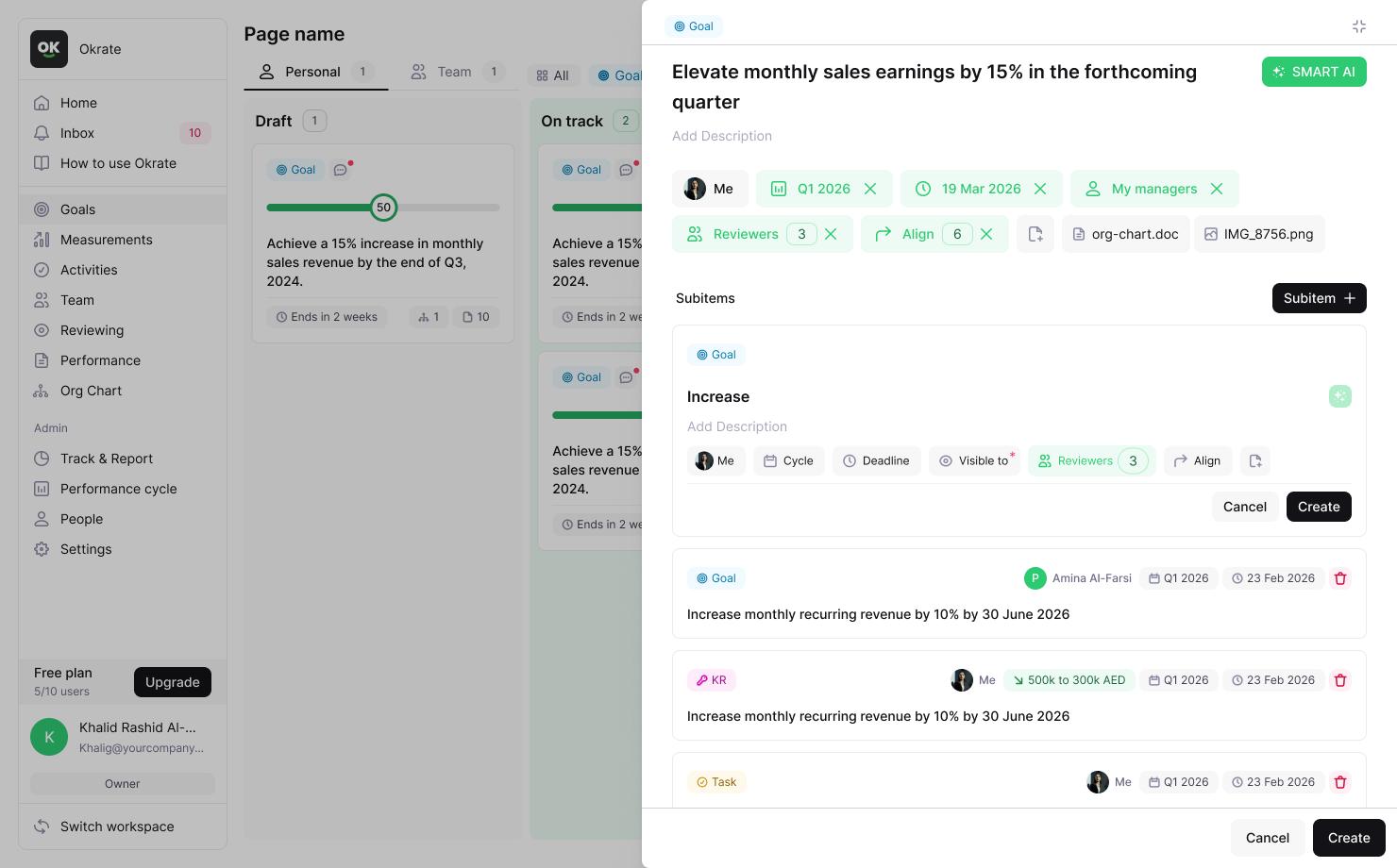
Employees and managers can set goals, define measurable key results and attach KPIs to track progress. This makes it easier to see what each person is working toward, how success is measured, and how individual work contributes to team or company priorities.
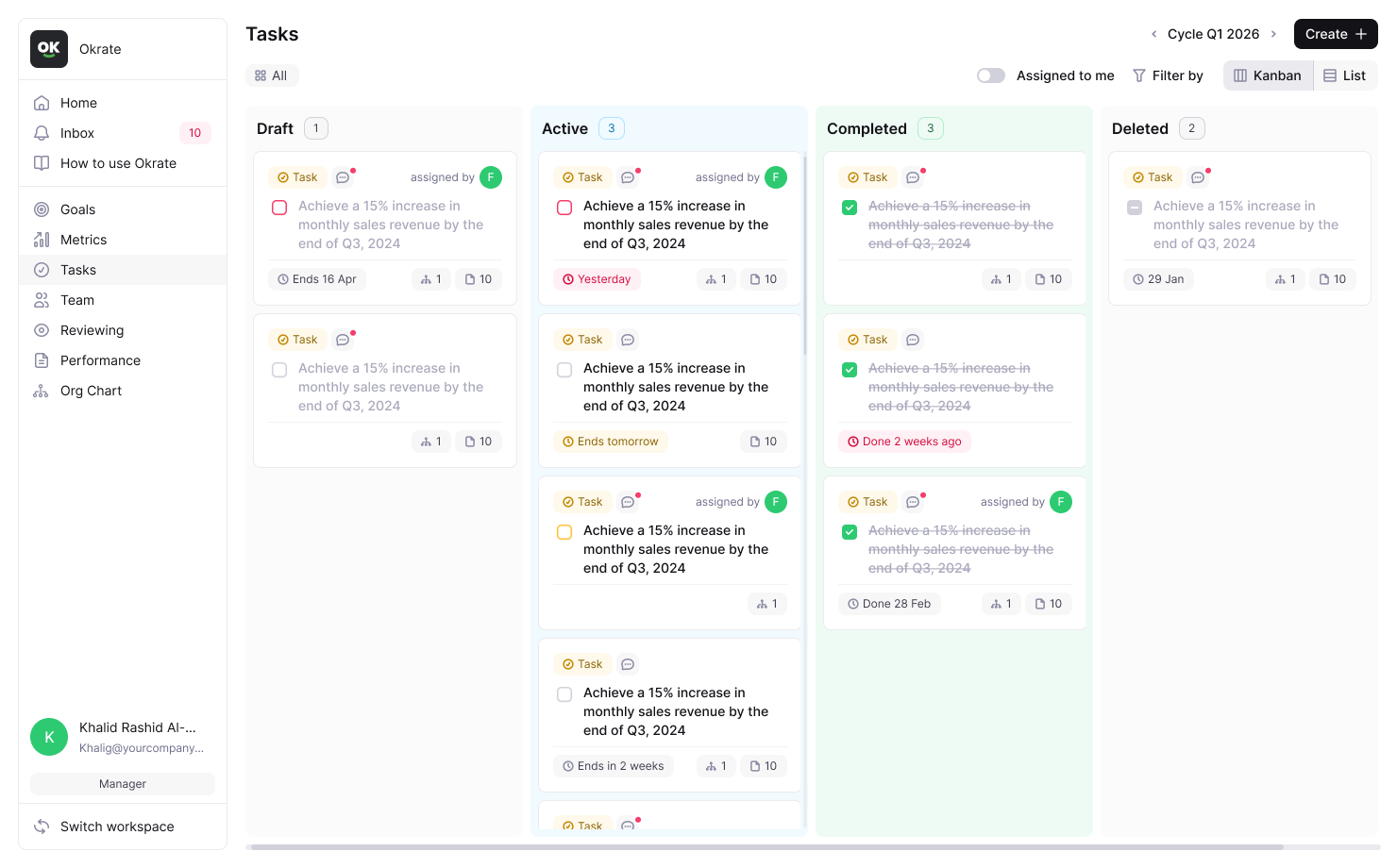
Milestones and tasks
Large goals can be broken down into milestones and actionable tasks. This helps employees understand not only the final target, but also the specific steps needed to get there.
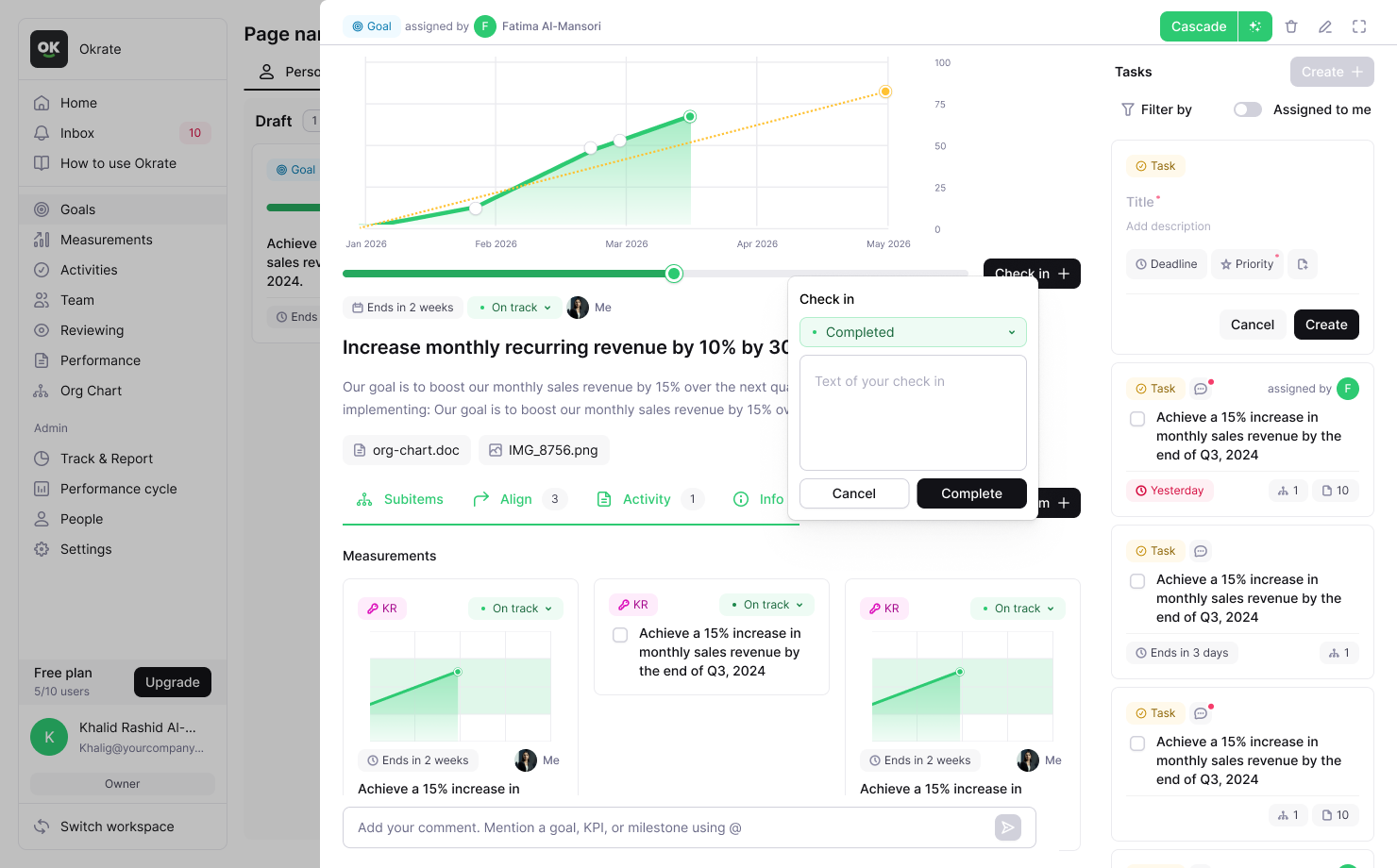
Check-ins
Regular check-ins help managers and employees discuss progress, blockers, priorities and support needs before the formal review stage. This keeps performance management continuous, not annual.
Feedback
Okrate supports feedback connected to goals and performance progress. Managers can give timely input, employees can receive clearer guidance and performance discussions become more specific and useful.
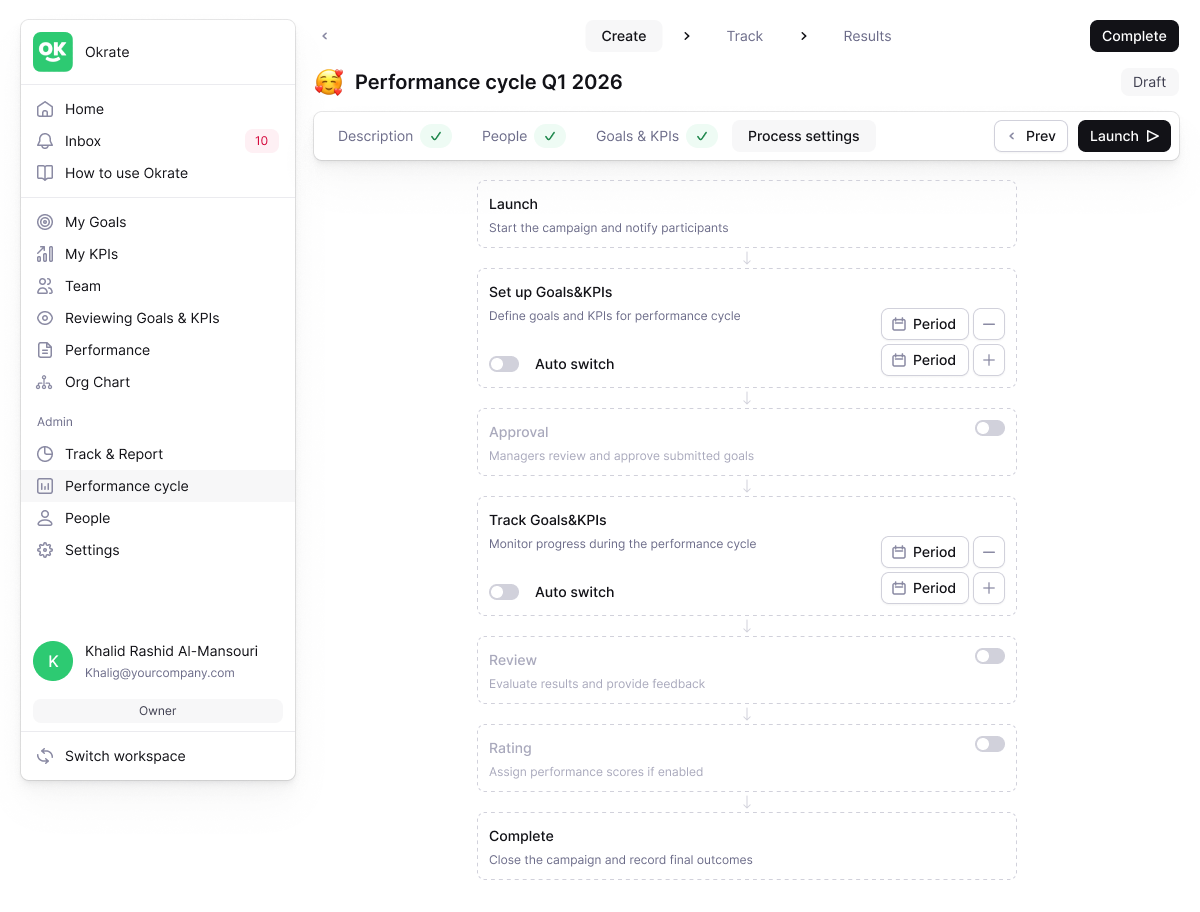
Performance cycles
HR can run structured performance campaigns for departments or employee groups, with clear stages, deadlines, participants and progress tracking.
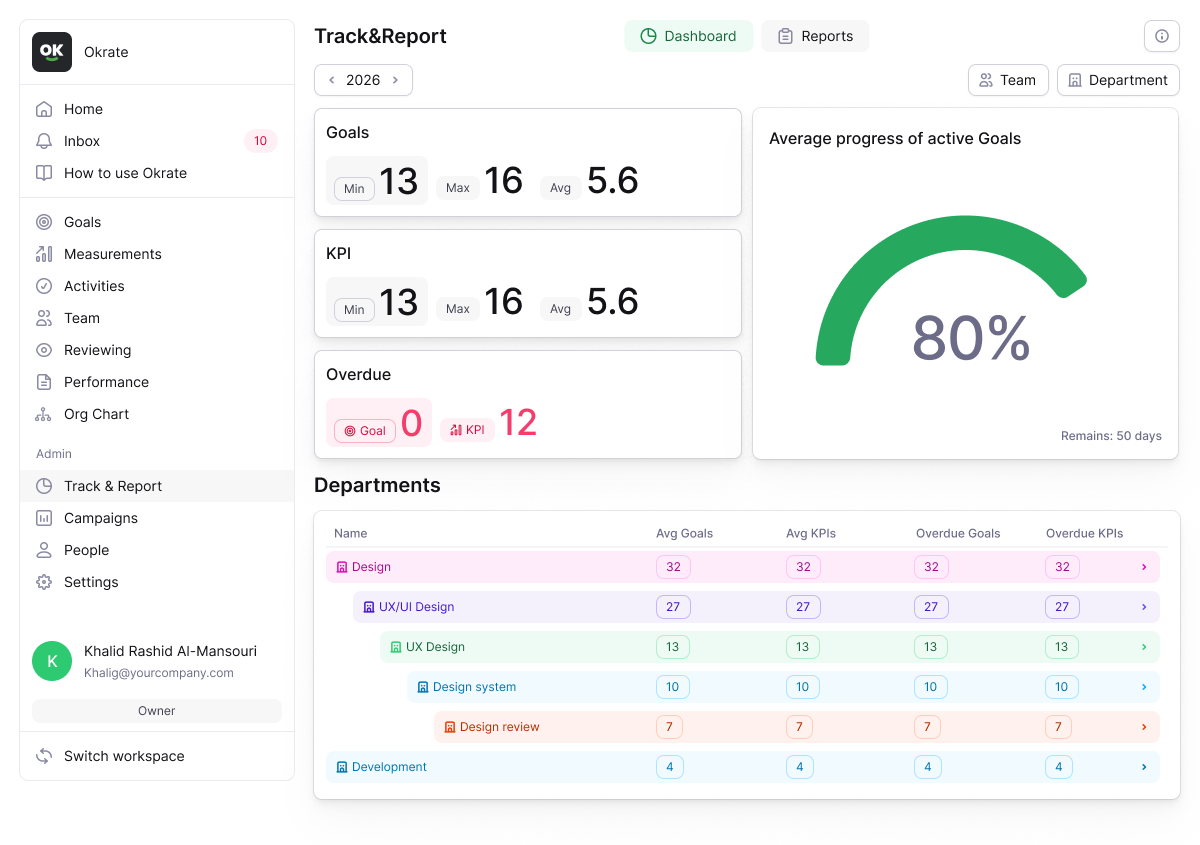
Real-time analytics
Managers and HR can see progress as it happens — goal completion, KPI updates, task status and overall performance trends — instead of waiting until the end of the review period.
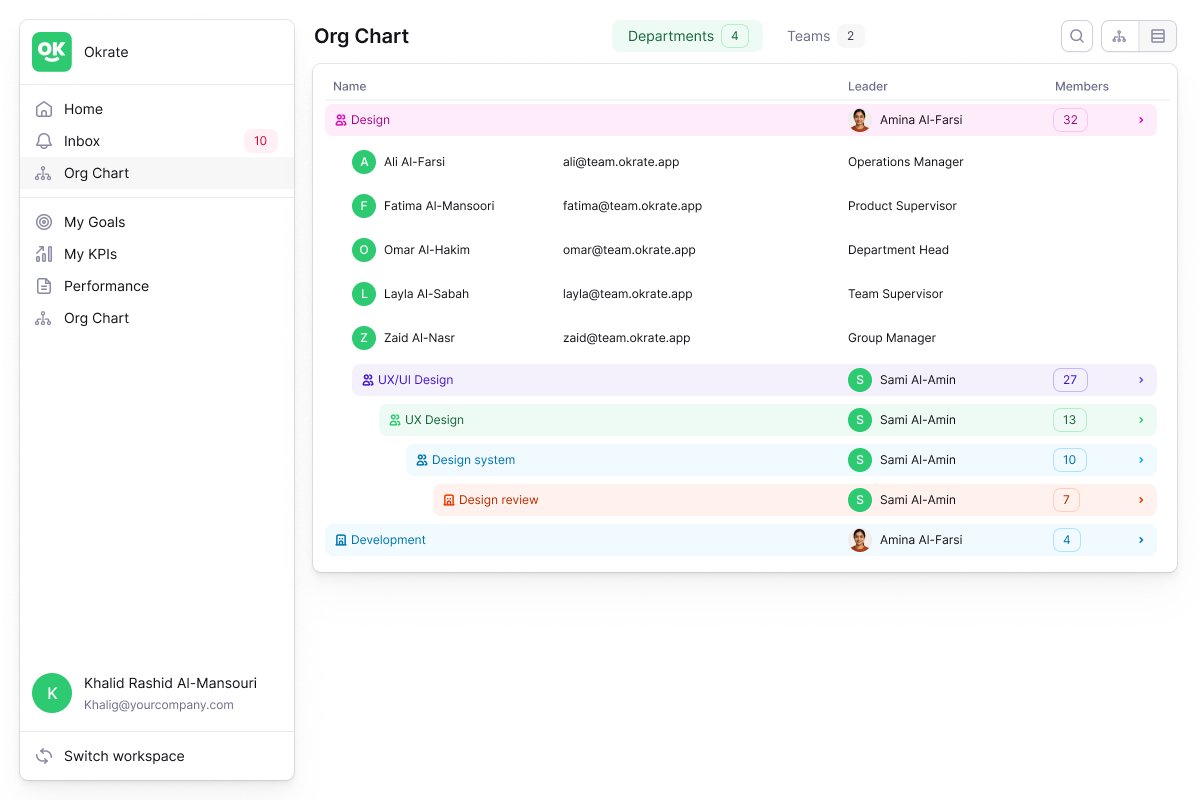
Org chart
The company structure helps clarify reporting lines, ownership, teams, managers and goal visibility across the organization.
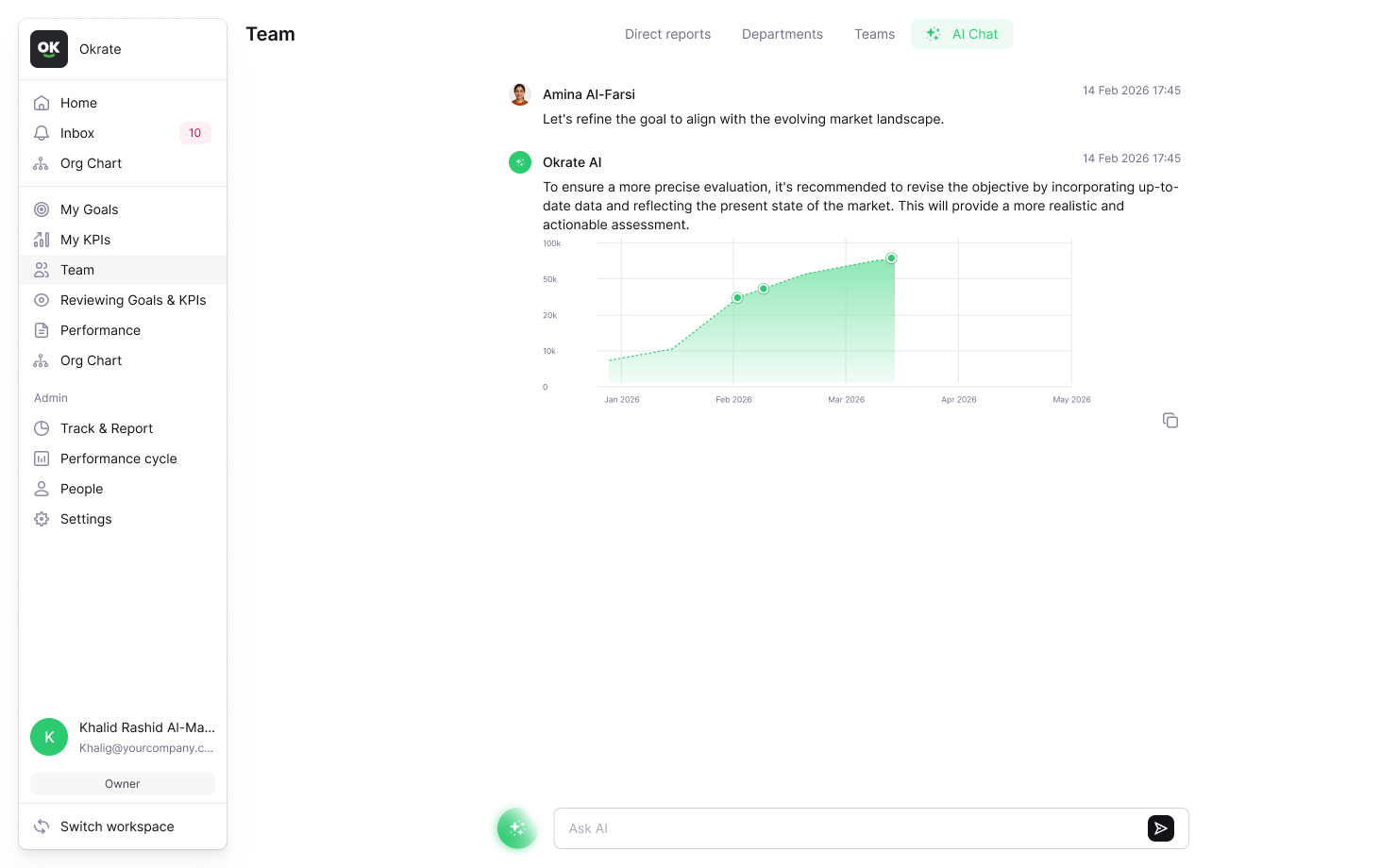
AI assistant
AI helps managers and HR work with performance information more efficiently, prepare feedback and reduce manual effort during performance processes.
Okrate does not turn performance measurement into a complex administrative process. Its value is that it keeps performance clear, connected and easy to manage for everyone: HR, managers and employees.
Measuring employee performance is not about finding one perfect score. It is about building a fair and useful picture of how people contribute, where they need support and how the organization can perform better.
The strongest systems combine clear goals, role-specific metrics, manager feedback, multi-source input and regular performance conversations. They use data, but they also leave space for context. They create accountability, but they also support development.
When performance measurement is designed well, employees understand what is expected of them. Managers make better decisions. HR gains visibility into team health and performance trends.
And the organization moves from judging performance after the fact to improving it continuously.