Performance reviews have been around for decades, yet many companies still struggle to make them useful. Done right, they support employee development, clarify expectations and strengthen engagement. Done poorly, they create anxiety, miscommunication and frustration.
In this article, we’ll explore what makes a performance review meeting meaningful and how HR professionals and managers can run them with confidence. From preparation to structure and common mistakes to follow-up.
Why Performance Reviews still matter?
A performance review is a structured conversation between a manager and an employee to discuss past performance, align on expectations, give and receive feedback, and set goals for future growth. Depending on the company, this might happen quarterly, bi-annually or annually.
With the rise of continuous feedback, OKRs, KPIs and agile performance cycles, some companies question whether formal reviews are still needed. They absolutely are but only if they’re done well.
Unfortunately, many reviews fail. According to Gallup, only 14% of employees strongly agree that performance reviews inspire them to improve. That’s not because employees don’t want feedback, it’s because the process often feels formal, one-sided or disconnected from day-to-day work.
In today’s workplace, where clarity, psychological safety and purpose matter more than ever, performance reviews need to be redesigned. When reviews are thoughtfully prepared, well-timed and two-way, they become a moment of trust and alignment, not a source of anxiety.
How to prepare for a Performance Review meeting
A great performance review doesn’t start when the meeting begins. According to Harvard Business Review, up to 70% of the success of a performance conversation depends on what happens before the meeting itself. So, what does good preparation actually look like?
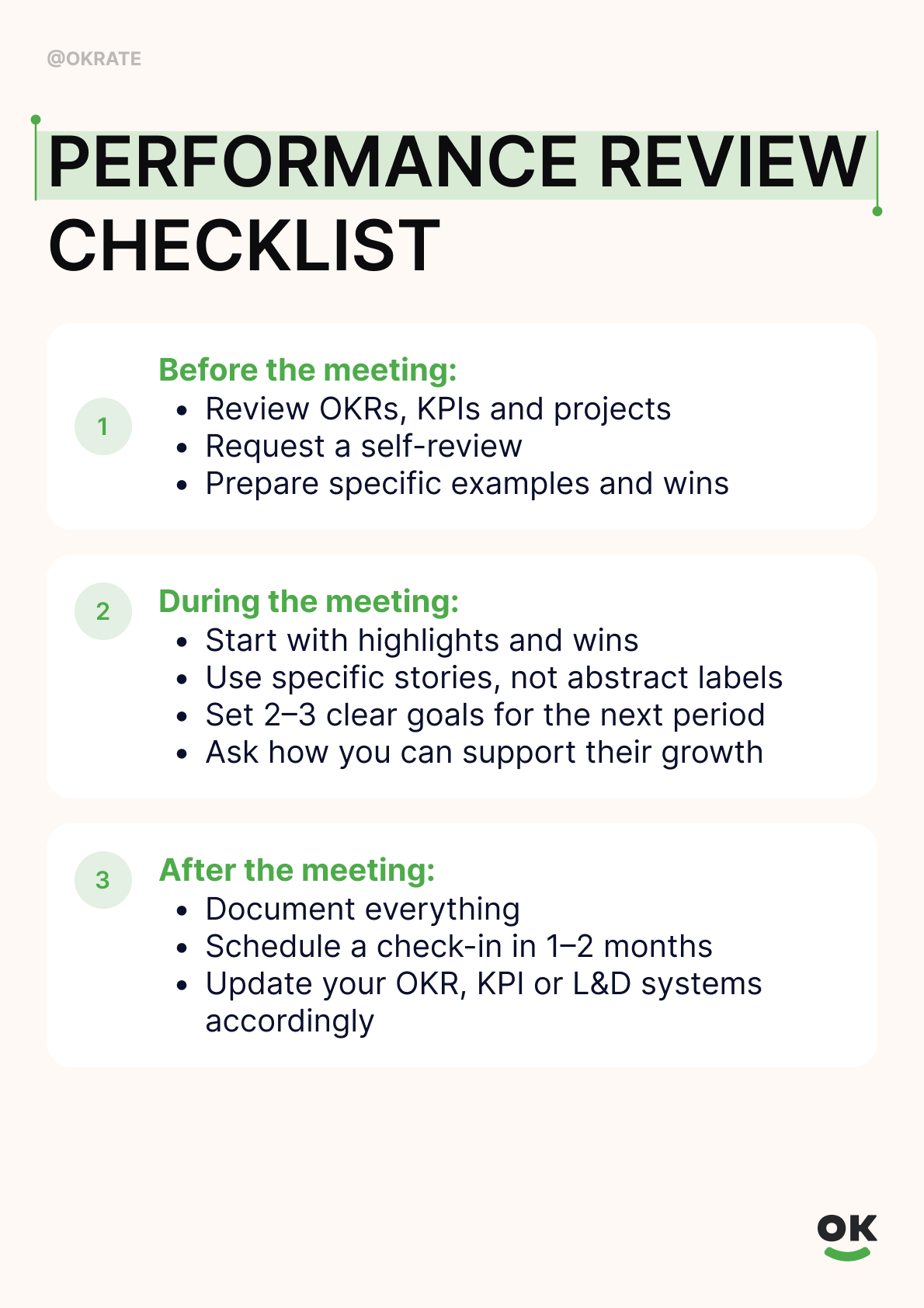
First, it means gathering relevant and concrete information. This includes reviewing recent performance metrics such as KPIs and OKRs, project outcomes, 360° feedback and results from regular 1:1s. Analyze what was done, what worked, where there were difficulties, look for patterns.
Second, review past goals. Look at the objectives you set in your last review or during check-ins. See which goals were achieved, which weren’t achieved and why, and what external factors may have influenced the outcome. This context is important for framing the current review in terms of growth and progress, rather than separate results.
Finally, think about the purpose of the communication. Performance reviews should never feel like a surprise inspection. Instead, frame them as a constructive dialogue aimed at alignment and support. Let the employee know the purpose of the meeting: to discuss what’s working, identify roadblocks and agree on priorities for the future. A clear agenda helps lower anxiety and increase focus.
Good preparation signals respect and it tells your team: “I’ve taken the time to understand your work and I’m here to help you succeed”.
Common mistakes that undermine the effectiveness of Performance Reviews
Even with the best intentions, many performance reviews fail, cause frustration and disengagement. The reason often lies not in the concept of the review itself, but in how it’s done. One of the most common mistakes managers make is turning the review into a one-way conversation. They speak too much, give top-down feedback and miss the opportunity to really listen. This makes the meeting feel more like a judgment than a dialogue.
Another issue is focusing only on what went wrong. While it’s important to address challenges, skipping over what went well (even small wins) can leave employees feeling unappreciated and discouraged. General comments like “You need to be more proactive” don’t help if they aren’t tied to real examples or discussed in a way that helps the employee understand how to improve.
Finally, many reviews end with no clear next steps. Goals are mentioned, but no one follows up and nothing really changes. Over time, this undermines trust in the process.
To make performance reviews more valuable, shift your approach from “evaluation” to “exploration”. Ask questions: What are you proud of? What was challenging? What support would help you grow? These simple questions open the door to honest conversation and help move from criticism to collaboration.
The ideal Performance Review structure
You don’t need a complicated framework to run a great performance review. What matters is clarity, focus and an interest in the employee’s experience. A helpful review starts by recognizing what’s going well. It means taking time to highlight real wins, big or small and acknowledging the effort behind them. Doing this first sets a constructive tone and builds psychological safety.
After that, explore the areas that need attention. Be specific, use real examples to frame the conversation and focus on what the person did. Avoid making it personal or vague. The goal is to identify together what can be improved and how. Ask the employee how they experienced those situations and what they think might help.
Next, check how their work aligns with team and company goals. Revisit existing KPIs or OKRs: are they still relevant, are they clear? If something feels misaligned, talk about it — this is a chance to bring clarity and reset priorities if needed.
Finally, agree on what comes next. Choose one or two specific development areas and turn them into clear, achievable goals. Define how progress will be supported. A review that ends with action is far more likely to drive real improvement than one that just points out gaps.
Why employees fear reviews and what you can do about it
It’s common for employees to feel anxious before a performance review. Often, they fear unexpected criticism or being evaluated. This fear usually comes from past experiences where feedback was unclear, the purpose of the meeting wasn’t communicated or they felt judged instead of supported.
To reduce this anxiety, start by setting clear expectations. Let your team know in advance what the review will cover, and share a simple agenda. When people know what to expect, the conversation feels less stressful. Remind them that the main goal of performance review is to reflect, learn and plan ahead.
If you already have regular 1:1s, make it clear that the performance review is just a deeper version of what you’ve already been talking about.
Follow up after the meeting
A performance review shouldn’t end when the meeting ends. In fact, what you do after the meeting determines whether anything discussed turns into action. Start by sending a short summary — a clear recap of what was discussed, what goals were set and what support was agreed.
Moreover, schedule a follow-up check-in in a few weeks or a month, depending on what was discussed. The point is to stay connected to progress and avoid letting the review fade into memory.
Then, track the goals you discussed. Don’t hide them in spreadsheets or docs that no one opens. Use a system that makes them visible and actionable through a shared dashboard, tracker, etc. This keeps progress transparent.
Performance reviews don’t need to be formal or scary. They should be honest, structured conversations that help both the employee and the organization grow. They align efforts, good relationships and open space for development.