The difference between a focused, high-performing organization and one that constantly feels busy but unfocused often comes down to one thing: how goals are set and connected.
Many companies invest time in defining ambitious strategies at the top, but struggle to translate those priorities into meaningful actions at the team and individual level. Employees work hard, but often can’t clearly explain how their daily tasks contribute to company success. Managers feel pressure to deliver results, yet lack a shared structure to align priorities across teams.
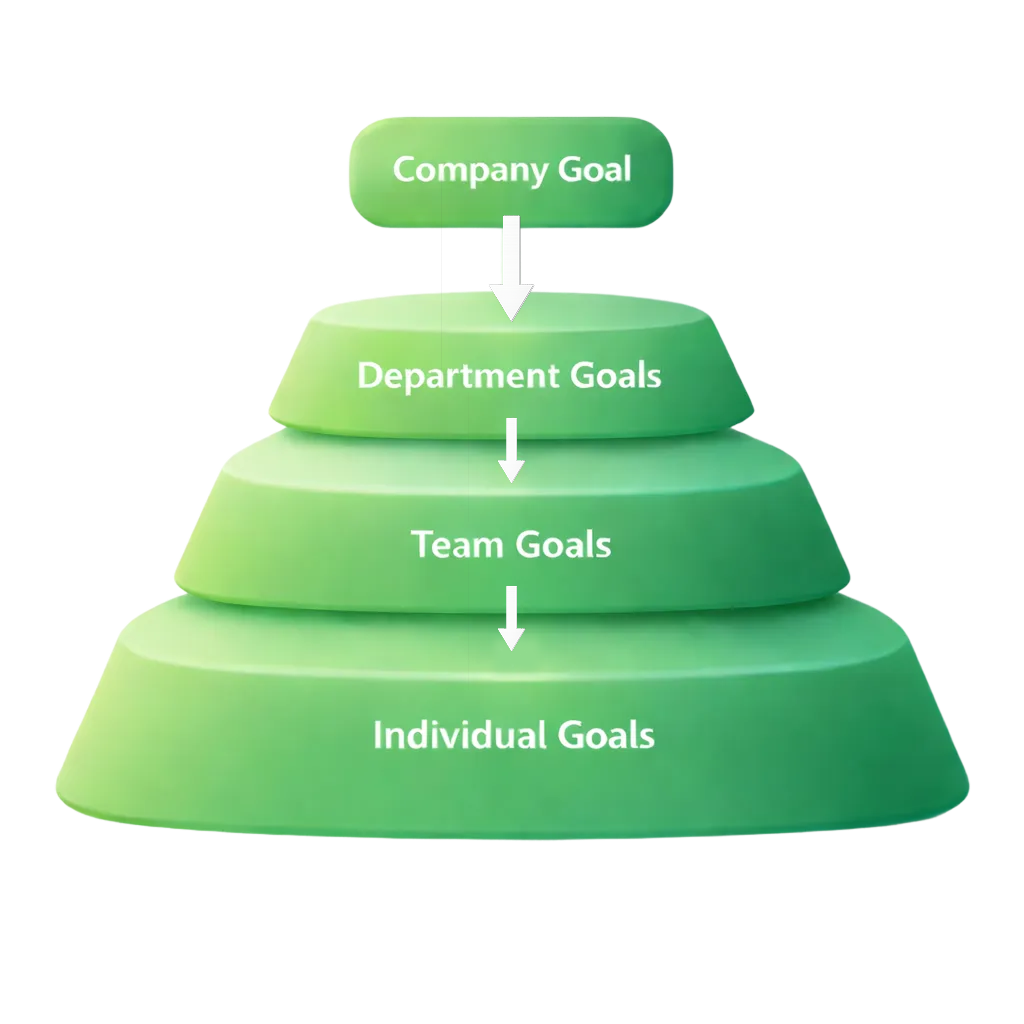
Cascading goals connect company-level objectives with department, team, and individual goals. They help organizations move from abstract strategy to clear execution, creating alignment, accountability and clarity at every level. Moreover, cascading goals allow people to understand not only what they are working on, but why it matters.
In this article, we’ll explore what cascading goals are, why they matter, common pitfalls to avoid and how HR and managers can implement them in practice.
What Are Cascading Goals?
Cascading goals are strategic objectives that go through the organization from top to bottom.
Leadership starts by defining clear company-level goals. Departments then translate those goals into priorities relevant to their function. Managers work with teams and individuals to define goals that support departmental objectives. Each layer builds on the one above it.
The purpose is simple: to ensure that individual work is meaningfully connected to organizational strategy.
Cascading goals are not about assigning tasks from the top down. Instead, they provide direction and context, while still allowing teams and employees to decide how they will contribute. This balance between alignment and autonomy is what makes cascading goals powerful.
Cascading Goals vs. Top-Down Goals and OKRs
There is no single correct goal-setting approach for every organization. Many companies combine different frameworks depending on their size, culture and maturity.
Top-down goals focus on leadership defining objectives and distributing them downward. While this can create clarity, it often limits ownership and engagement at lower levels.
OKRs emphasize outcomes and transparency, encouraging teams to set ambitious goals aligned with company priorities. However, without clear structure, OKRs can become fragmented or disconnected.
Cascading goals stand between these approaches. They provide structure and alignment while still encouraging teams and individuals to define their own goals within a shared direction. In practice, many organizations use cascading goals alongside SMART goals or OKRs to create a system that balances clarity, flexibility and accountability.
Why Cascading Goals Matter
Strategic alignment
Cascading goals help ensure that everyone is moving in the same direction. When company priorities are clearly translated into department and team goals, it becomes easier to prioritize work and say no to initiatives that don’t support strategic objectives.
If a task or project doesn’t connect to a company objective, it is likely not a priority. This alignment reduces wasted effort and helps teams focus on what truly matters.
Clarity of purpose
Cascading goals also bring clarity at the individual level. Employees can see how their work contributes to broader outcomes, which increases motivation and engagement.
When people understand the impact of their efforts, work feels more meaningful. Cascading goals reduce duplication, prevent teams from working at cross-purposes and help organizations use their resources more effectively.
Organizational flexibility
As cascading goals are interconnected, they make it easier to adapt when priorities change. When leadership updates strategic goals, teams can quickly assess which objectives need adjustment.
This flexibility is especially important for distributed and fast-growing organizations. Cascading goals allow teams to stay aligned without constant top-down control, supporting autonomy.
Myths About Cascading Goals
One common myth is that cascading goals lead to micromanagement. In reality, effective cascading goals empower teams by giving them context and freedom to decide how they will contribute.
Another myth is that cascading goals create bottlenecks. This usually happens when the process is treated as a rigid hierarchy. Cascading goals should function as a network of coordinated efforts, rather than as dependent events in which progress can be blocked at each level.
How to Create Cascading Goals in Practice
Start with Clear Company-Level Objectives
Cascading goals begin with clarity at the top. Leadership must define a small number of clear, measurable company goals that reflect both short-term priorities and long-term direction.
These goals should be specific enough to measure progress, but inspiring enough to engage people across the organization.
Align Department Goals to Strategic Priorities
Once company goals are clear, departments define how they will contribute to it. This requires clear communication of strategy so teams understand the direction.
Rather than assigning tasks, leaders should explain the outcome the organization is trying to achieve and allow departments to decide how they can support it.
Align Team and Individual Goals Through Dialogue
Managers play a critical role in translating department priorities into team and individual goals. Employees should be involved in setting their own goals, while managers should ensure that they are aligned and achievable.
Goals should be reviewed together, and managers should regularly check whether individual goals still match to higher-level objectives.
Ensure Visibility Across Teams
Cascading goals only work when they are visible. Teams need to see how their work connects to others and how progress is tracked.
Visibility supports accountability and helps prevent misunderstanding. When goals are transparent, teams can coordinate more effectively and avoid working on conflicting priorities. Cascading goals should also be connected to performance reviews, and development conversations to reinforce their importance.
Best Practices for Cascading Goals
Cascading goals are more effective when treated as a living system. Goals should be specific and measurable, reviewed regularly and adjusted as priorities change. Transparency should be encouraged so teams can share progress and ask questions.
A Clear Example of Cascading Goals in Practice
Company-level goal: Increase annual recurring revenue (ARR) by 20% by the end of the year.
Department-level goals
Sales department goal: Increase qualified sales pipeline by 25% and improve win rate to support revenue growth.
Marketing department goal: Increase the number of sales-qualified leads by 30% and improve lead quality.
Customer Success department goal: Reduce churn by 15% and increase expansion revenue from existing customers.
Team-level goals
Sales team:
Increase closed deals from mid-market customers by 20% by the end of Q4.
Marketing team:
Launch and optimize 3 campaigns targeting high-intent industries to generate 500 SQLs in six months.
Customer Success team:
Improve onboarding completion rate to 95% and reduce time-to-value to 30 days.
Individual-level goals
Sales Manager:
- Coach team to increase average win rate from 18% to 22%
- Run bi-weekly deal reviews and monthly skill training sessions
Account Executive:
- Close 15 new deals per quarter with an average deal size of $12,000
- Maintain a personal win rate of 20%+
Marketing Specialist:
- Create and test 10 campaign assets per quarter
- Achieve a conversion rate of 8% from MQL to SQL on assigned campaigns
Customer Success Manager:
- Conduct quarterly business reviews with top 20 accounts
- Identify and close $100K in expansion opportunities by year-end
How Okrate Supports Cascading Goals
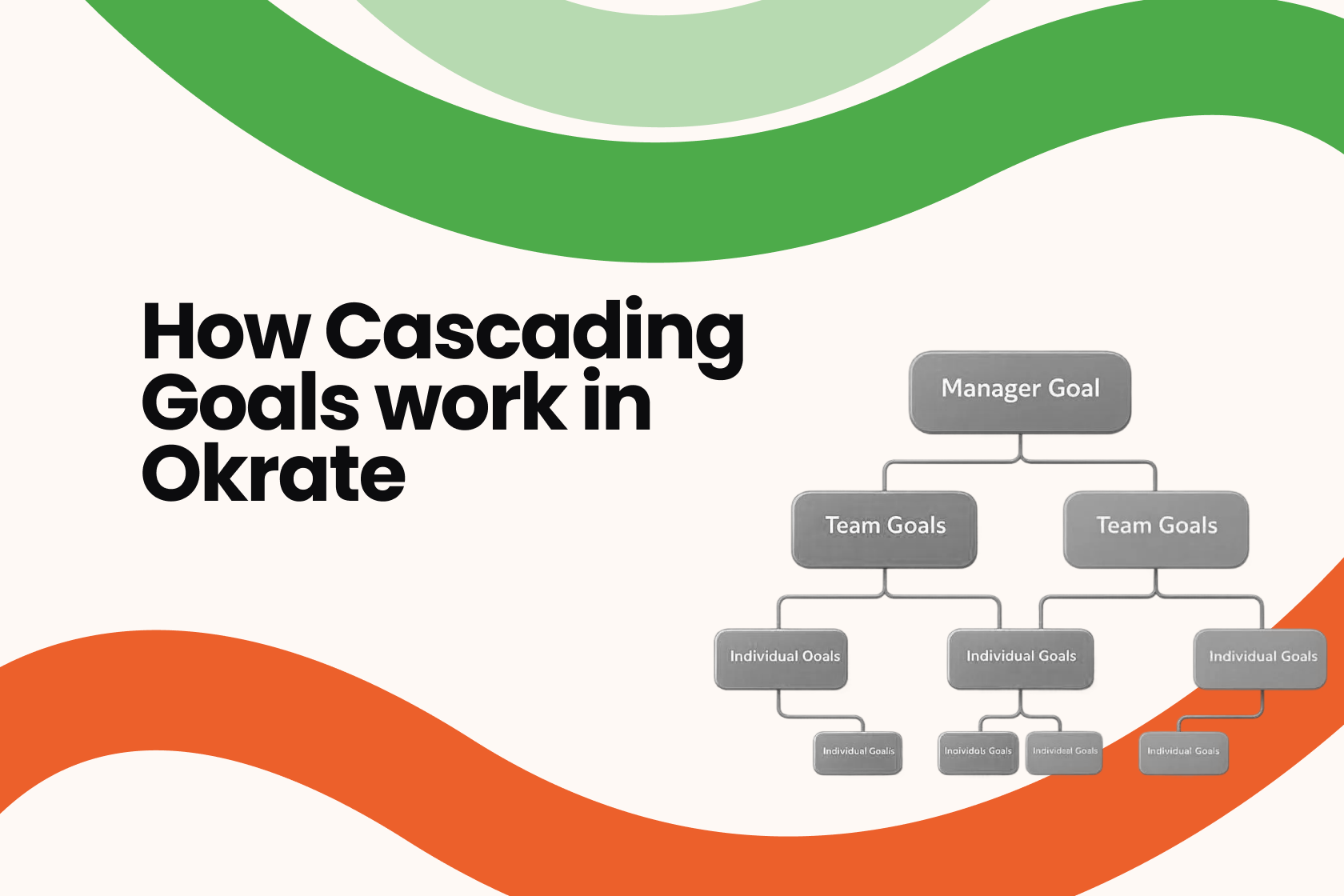
Cascading goals don’t have to mean a complex top-down system where company goals automatically go through every department and role. In practice, many organizations implement cascading in a more natural and manager-driven way.
In Okrate, cascading goals are built through managerial ownership.
A manager starts by creating their own goal, for example, a departmental or team objective. From this goal, they can cascade it directly to their direct reports, creating linked goals for employees that clearly support the manager’s objective.
This means cascading happens:
- from manager to team
- from parent goal to child goals
- with clear ownership at each level
Rather than pushing goals top-down across the entire organization, Okrate focuses on how managers actually set and distribute goals in day-to-day work.
How cascading works in Okrate
- The manager sets a goal with clear results, milestones and deadlines
- Based on this goal, the manager creates linked goals for team members
- Each employee's goal is directly linked to the manager's goal
- Progress is visually shown on dashboards
- Managers can track progress in real time

Cascading goals are not just a goal-setting technique. They are a way to connect strategy to execution, leadership intent to employee action and long-term vision to daily decisions.
Cascading goals give employees clarity, managers structure and leaders visibility into how strategy is actually being executed.
Cascading goals give employees clarity, managers structure and leaders visibility into how strategy is actually being executed.